

Introduction
A family relocation usually comes with a long checklist: visa, housing, flights, paperwork — and then school.
The problem? Your family’s move doesn’t always follow the school calendar.
A child may need to leave school in India halfway through the academic year and start again in another country. The new school may follow a different curriculum, have different admission dates, or teach concepts in a different sequence.
For NRI and expat families, education needs to be more than flexible.
It needs continuity.
That’s where an online school for NRI students can become a practical option — particularly for families who move between countries or expect to relocate again.
Why Moving Abroad Can Disrupt Schooling

Changing countries can mean changing much more than a classroom.
Your child may face:
- Different academic calendars
- Different curricula
- Mid-year admission challenges
- New teaching methods
- Different subject sequences
- New classmates and teachers
- Gaps or repetition in learning
For a family that moves once, this can be manageable.
For families who relocate regularly, repeating the process every few years can become exhausting.
An online school for kids living abroad can provide a consistent academic environment while the family’s location changes.
The address changes.
The school doesn’t have to.
Can You Join an Online School Mid-Year?
This is one of the first questions relocating parents should ask.
Traditional schools often have fixed admission windows, while some online schools offer mid-year school admission for expats or rolling admissions.
However, policies differ between schools.
Before enrolling, ask:
- Do you accept students after the academic year has started?
- Which grades are open for admission?
- How is previous schooling assessed?
- Can my child start immediately?
- Are there curriculum requirements before joining?
For families moving countries mid-year, this flexibility can be particularly valuable.

click to know more
Don’t assume rolling admissions are available.
Confirm the intake policy before you plan around it.
What Should a Genuine Online School Provide?
When searching for an online international school, parents may encounter everything from full-time schools to tutoring platforms and self-learning programmes.
They aren’t interchangeable.
A structured online school may provide:
- Live teacher-led classes
- A defined curriculum
- Regular assessments
- Student progress tracking
- Teacher and academic support
- School activities
- Academic records and documentation
The important thing is to understand exactly what the school provides and what qualification your child receives.
Live Classes Matter — Especially During Relocation
Moving countries can already disrupt a child’s routine.
That’s why an online school with live classes can provide something important: consistency.
Instead of learning entirely through recorded content, students can have:
- Real-time teacher interaction
- Scheduled lessons
- Class discussions
- Questions answered during lessons
- Interaction with other students
For younger children especially, this structure can help make online learning feel more like school, rather than independent screen-based study.
Before enrolling, ask:
How much of the teaching is live, and what happens when a student misses a class?
How Do Online Classes Work Across Time Zones?
This is a major consideration for international families.
A live class that works perfectly in India may be inconvenient for a family living in North America.

When comparing schools, ask:
- What time are live classes scheduled?
- Which time zones does the school commonly serve?
- Are recordings available when a class cannot be attended?
- Is there flexibility around unavoidable time-zone conflicts?
For families considering online classes across time zones, this should be checked before admission, not after the timetable is released.
What If We Move Again?
This is where curriculum continuity becomes important.
Imagine a child studying in India, moving to Dubai, and then relocating to Canada.
Changing schools every time can mean changing:
teachers → curriculum → timetable → assessment system → academic records.
A consistent online school can reduce some of that disruption.
This is why some families look for an online school that travels with you.
The goal isn’t simply convenience.
It’s curriculum continuity for expat children.
Before enrolling, ask whether the school can continue serving your child if your family relocates again.
Which Curriculum Should NRI Students Choose?
There isn’t one universal answer.
The right choice depends on where your child is now and where they may study next.
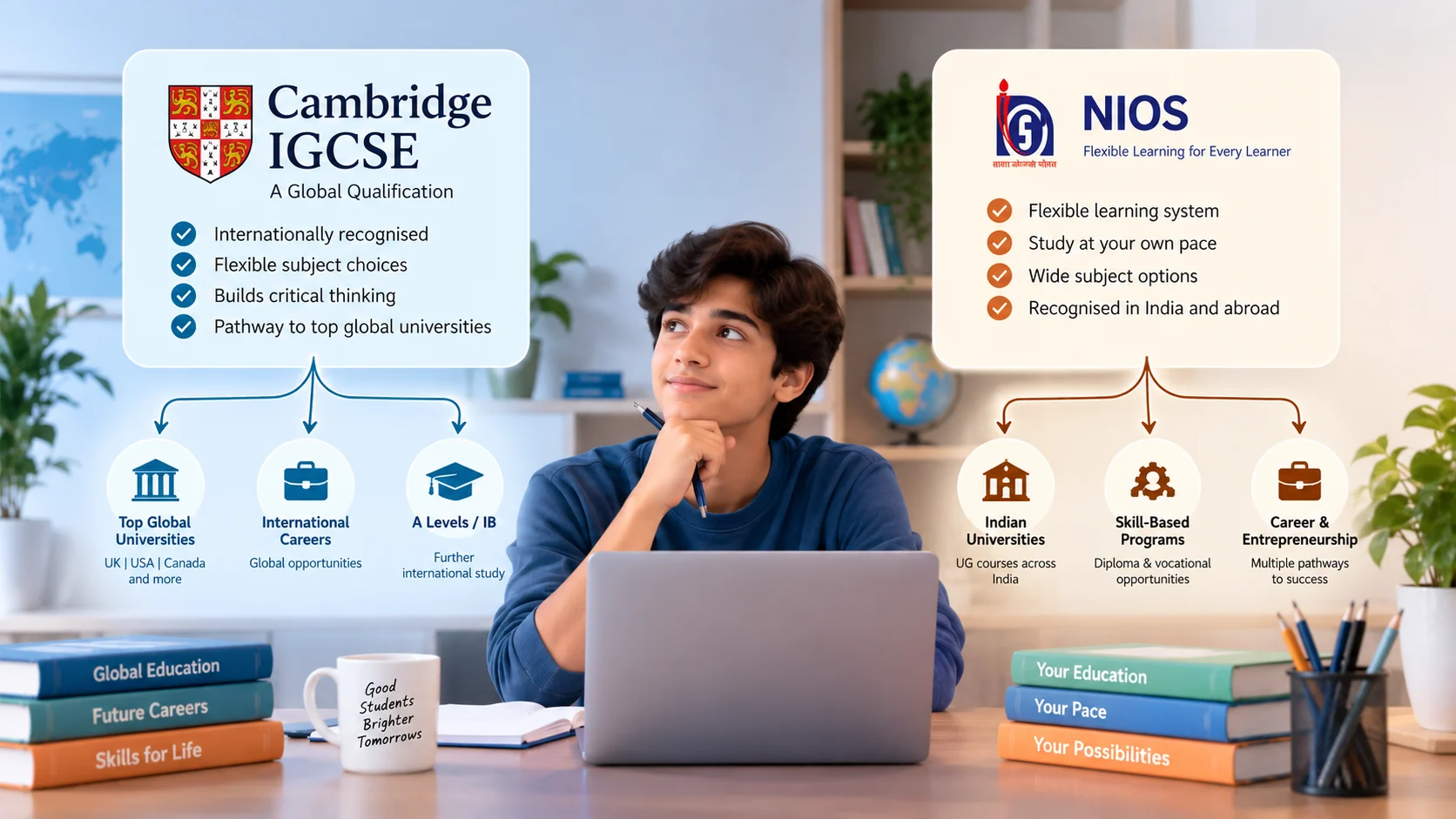
Cambridge IGCSE
A Cambridge IGCSE online school can be worth considering for families seeking an international curriculum and potentially planning for higher education across different countries.
NIOS
An NIOS online school pathway may be relevant for families who want an Indian education route, particularly when returning to India is part of their longer-term plan.
Cambridge vs NIOS for NRI Students
The better question isn’t Which curriculum is more prestigious?
Ask:
Where is my child likely to study after school?
For families considering returning to India, investigate the specific higher-education requirements that may apply. For families targeting international universities, compare the curriculum with the entry requirements of the countries and universities you’re considering.
In other words:
Choose the destination first. Then work backwards to the curriculum.
What About Nursery to Grade 12?
For families with younger children, changing schools repeatedly can become particularly disruptive.
An online school for nursery to grade 12 can offer the possibility of staying within one broader school environment as the child progresses.
But don’t assume that one school’s accreditation or recognition automatically covers every grade.
Ask:
- Which grades are offered?
- Which curriculum applies at each stage?
- What accreditation or recognition applies to each programme?
- Can the child progress through the same pathway?
- What happens at key transition points?
Grade continuity matters as much as curriculum continuity.
Can Technology Help Parents?
Parents living abroad often have plenty to manage already.
An AI-enabled online school can make progress tracking more visible by helping organise learning data and identify areas that may need attention.
Look for a platform that gives parents useful information about:
- Attendance
- Progress
- Assignments
- Learning activity
- Areas requiring attention
Ask to see the actual parent dashboard before enrolling.
A screenshot tells you very little.
A live demonstration tells you much more.
What About Socialisation?
This is one of the most common concerns parents have about online education.

“Will my child miss out on friends and activities?”
That’s why parents shouldn’t evaluate an online school only by its academic timetable.
Ask what students can participate in outside regular lessons:
- Coding clubs
- Debate
- Art and drama
- Student leadership
- Wellness activities
- Projects
- Cultural or international activities
The exact activities vary by school.
The key question is:
Does the school create opportunities for students to interact, or is everything just lessons and assignments?
What Should NRI Parents Check Before Admission?
Before starting the online school admission process, use this checklist:
1. Accreditation
Who provides it, and can you verify it independently?
2. Curriculum
Does it match your child’s future academic plans?
3. Mid-year admission
Can your child join when your family relocates?
4. Time zones
Will live classes work with your new location?
5. Grade continuity
Can your child continue through the next academic stages?
6. Qualification
What certificate, diploma or academic record will the student receive?
7. University pathway
Check the requirements of the countries or universities your child may target.
8. Student support
What happens if your child struggles academically?
9. Parent visibility
Can you easily monitor progress?
10. Total cost
Ask for the complete fee structure in writing.
What If You’re Returning to India?
This deserves special attention.
If your family is abroad now but expects to return to India later, don’t choose a curriculum based only on your current location.
Think ahead.
“What will my child need when we return?”
Compare the curriculum, qualification, subject requirements and future admission pathways before making the decision.
For some families, an Indian curriculum may make sense. For others, an international pathway may better fit their plans.
There is no single best curriculum for returning to India for university without knowing the student’s intended course and institution.
FAQ
Is online school good for NRI students?
It can be a practical option for families who need academic continuity while living abroad or relocating. The right choice depends on curriculum, qualification, accreditation, teaching model and the child’s future plans.
Can expat children join an online school mid-year?
Some online schools offer rolling admissions, but policies vary. Ask specifically about mid-year admission before enrolling.
How do online schools handle different time zones?
Schools serving international students may schedule live classes around their student base and may provide recordings for missed sessions. Always confirm the actual timetable for your location.
What is the best curriculum for NRI students?
There is no universal answer. Cambridge vs NIOS for NRI students should be evaluated based on the child’s likely university destination, future location and academic goals.
Can my child continue if we move countries again?
Potentially, depending on the school’s geographic coverage, curriculum, admission policies and programme structure. Ask this question before enrolling if another relocation is likely.
Is an online school suitable for younger children?
It can be, but younger students may need more parental support and a structured learning environment. Look closely at live teaching, class size, teacher support and parent involvement.
How do I choose an online school for expats?
Start with five things: accreditation, curriculum, live teaching, relocation flexibility and qualification recognition. Then compare fees and additional services.
Final Thoughts
For NRI and expat families, online schooling isn’t simply about studying from home.
It’s about answering a much bigger question:
Can my child’s education remain stable while our family’s location changes?
The best option will depend on your child’s age, curriculum, destination, university plans and learning needs.
So before enrolling, verify the qualification, understand the curriculum, check mid-year admission, test the live-class schedule, ask about time zones and find out what happens if you move again.
Because when your family crosses borders, your child’s education shouldn’t have to start over every time.
Comments are closed