
Choosing the right curriculum is an important decision for parents. It influences not only what children learn in school but also how they approach problems, develop interests, build confidence, and prepare for higher education. For families exploring international education, the American curriculum is one option worth understanding.
Known for its broad subject choices, continuous assessment, and emphasis on critical thinking, the American education system gives students opportunities to explore different academic interests while building essential skills. Its flexible approach can also help students connect classroom learning with practical situations and future goals.
However, the American curriculum is not a single, identical programme followed by every school. Grade structures, subjects, graduation requirements, assessment methods, and diploma arrangements can vary by school and programme. Understanding these differences helps parents make a more informed decision.
This guide explains how the American curriculum works, what students learn at different stages, how grades and credits are used, what an American High School Diploma involves, and what parents should consider when exploring online American education.
1. Understanding the American Curriculum
1.1 What Is the American Curriculum?
The American curriculum is an educational approach based on the academic frameworks, learning standards, and school structures used in the United States. It generally combines core subjects with opportunities to explore electives, develop practical skills, and pursue individual interests.
Rather than focusing exclusively on memorising information, many American curriculum programmes encourage students to understand concepts, ask questions, analyse information, discuss ideas, and apply their knowledge.
For example, a science lesson might involve more than learning definitions from a textbook. Students may investigate a question, interpret observations, explain their findings, and present a conclusion. Similarly, English Language Arts may include reading, writing, discussion, research, and presentations.
The exact teaching methods and standards depend on the school and programme. Some schools follow state standards, while others use frameworks such as the Common Core State Standards for English Language Arts and Mathematics.
1.2 How Is the American School System Structured?
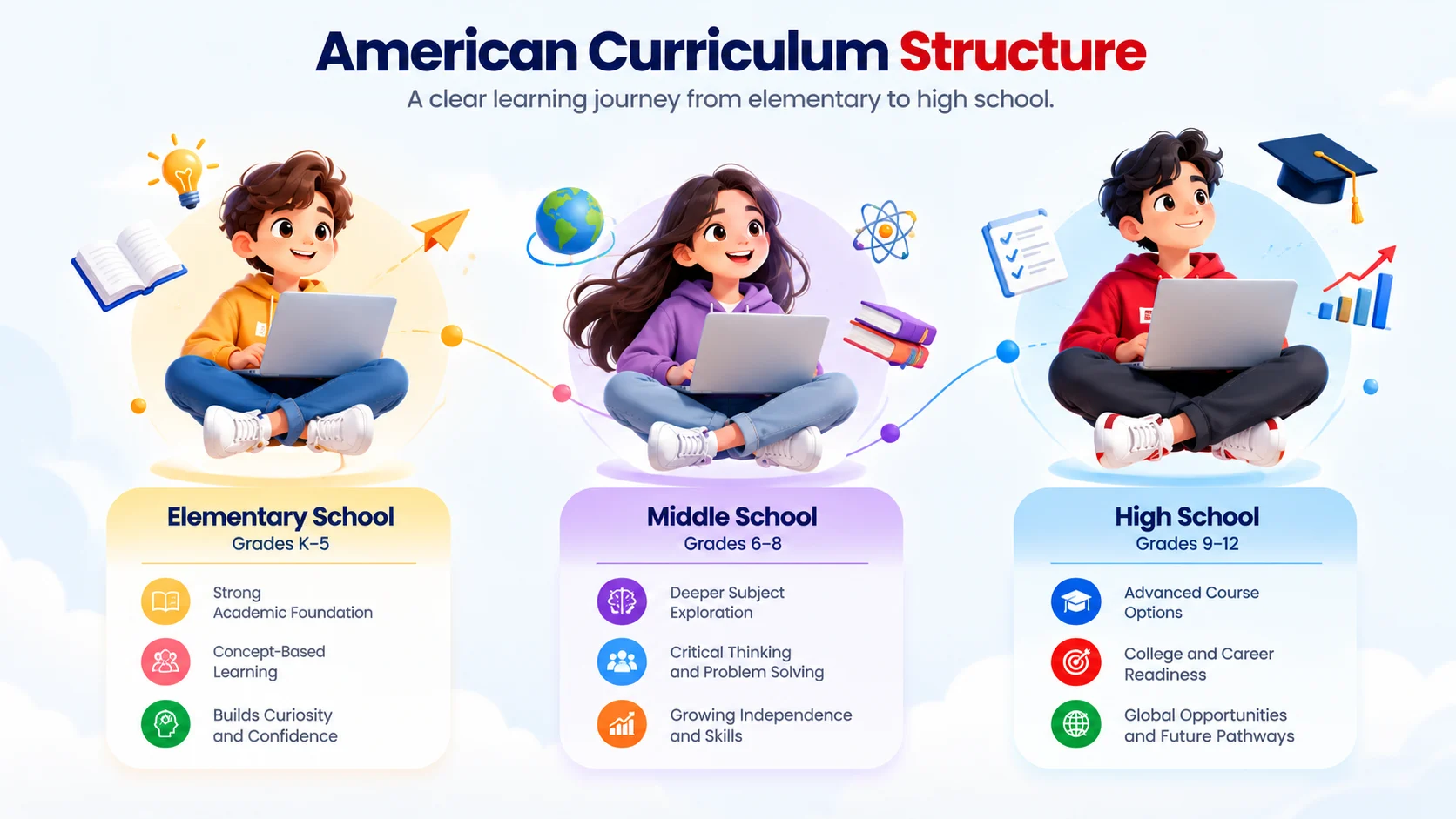
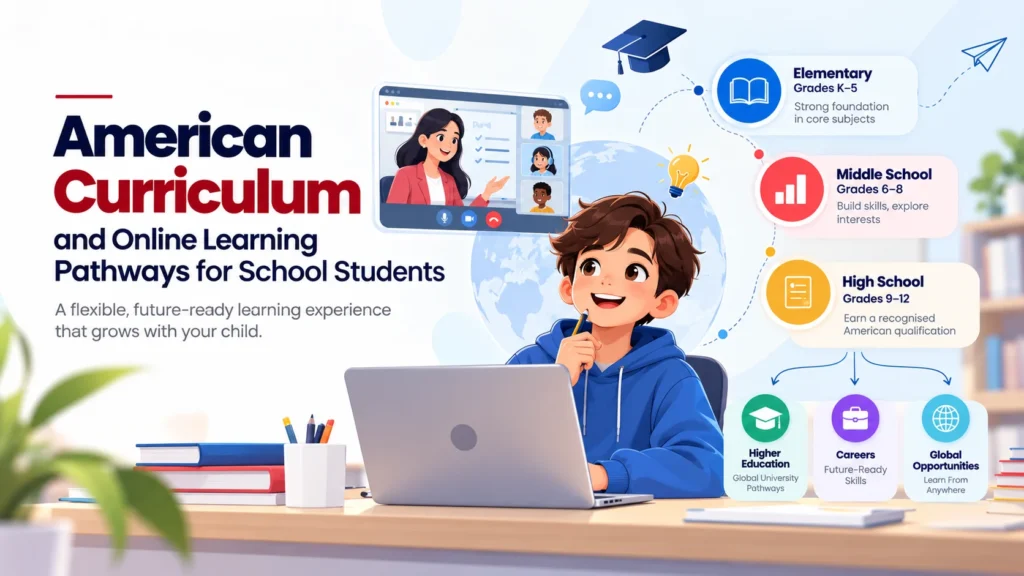
The American school system is commonly divided into three main stages: elementary school, middle school, and high school. The precise grade ranges may vary between schools and districts.
| Stage | Common Grade Levels | Main Learning Focus |
| Elementary School | Kindergarten–Grade 5 | Foundational literacy, numeracy, and general knowledge |
| Middle School | Grades 6–8 | Subject development, independent learning, and critical thinking |
| High School | Grades 9–12 | Advanced subjects, credits, graduation requirements, and future planning |
These divisions provide a general overview, not a universal rule. Some schools organise elementary and middle grades differently, and online programmes may offer specific grade ranges rather than the entire school journey.
For parents, the key is to understand the structure of the particular school being considered and how students progress from one grade to the next.
1.3 Key Features and Principles of American Education
The American curriculum is often associated with a broad, student-centred approach to learning. Its common features include:
- Conceptual understanding: Students learn the reasoning behind concepts instead of relying only on memorisation.
- Subject variety: Alongside core subjects, students may study arts, technology, languages, and other electives.
- Continuous assessment: Assignments, quizzes, projects, classroom participation, and examinations may contribute to academic evaluation.
- Critical thinking: Students are encouraged to compare ideas, evaluate evidence, and develop logical explanations.
- Practical application: Activities and projects can help students connect academic concepts with real-world situations.
- Individual interests: Elective choices may allow learners to explore subjects related to their strengths and future ambitions.
The extent to which these features appear in practice depends on the school, its teaching methods, and its academic requirements.
1.4 Understanding Grade Levels, Credits, and Academic Progression
Three terms are particularly important when exploring the American curriculum: grades, credits, and academic progression.
Grades identify a student’s school year, such as Grade 8 or Grade 10. They help establish the expected academic level and the sequence of learning.
Credits are units used by many high schools to record completed coursework. Students may need to earn a specified number of credits across different subject categories to qualify for graduation. The exact number and distribution depend on the programme.
Academic progression refers to moving through grades or completing the requirements for the next stage. Schools may consider course completion, subject performance, assessments, and other academic criteria.
Parents should not assume that all American curriculum schools follow identical credit requirements. Before enrolment, ask for the programme’s official academic plan, credit policy, and graduation criteria.
1.5 How Does the American Curriculum Differ from Other International Curricula?
The American curriculum differs from other international curricula in its structure, assessment approach, and subject pathways. A comparison can help parents identify which system suits their child’s needs.
| Factor | American Curriculum | Cambridge Curriculum | Indian Curriculum |
| Structure | Commonly organised by grades | Often organised around stages and qualifications such as IGCSE and A Levels | Depends on the board, such as CBSE or NIOS |
| Subject choices | Electives may be available, particularly in high school | Subject choices depend on the qualification and school | Subject choices depend on the board and grade |
| Assessment | May combine coursework, projects, tests, and examinations | Assessment varies by qualification and subject | Assessment varies by board and programme |
| Progression | May use course credits and graduation requirements | Usually follows the requirements of the selected qualification | Follows the relevant board’s progression and certification rules |
| Learning experience | Often provides broad subject exploration and flexible pathways | Offers structured international qualifications | Varies by board, with defined subject frameworks and examination requirements |
No curriculum is automatically the best choice for every learner. The right option depends on a child’s learning preferences, academic goals, intended university destinations, and the specific programme available.
Parents can explore the American Curriculum at K12 ONLINE SCHOOLS to understand the school’s published programme information.
2. Exploring the Different Stages of American Education
Each stage of the American school system builds on the learning developed in the previous years. The early grades establish core skills, middle school expands subject knowledge, and high school focuses on more advanced coursework and future planning.
2.1 Elementary School: Building Strong Foundations
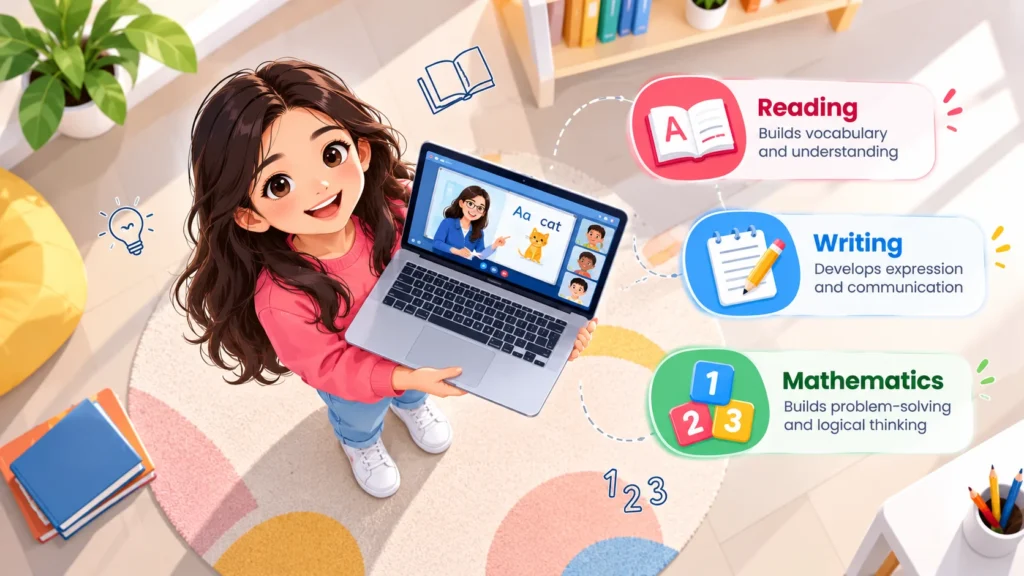
Elementary school introduces children to the essential skills they need for further education. The focus is on developing literacy, numeracy, communication, curiosity, and an understanding of the world.
Reading, writing, and mathematics
Students develop reading comprehension, vocabulary, spelling, sentence construction, number sense, and mathematical reasoning. These skills support almost every later subject.
Science and social studies
Children begin exploring natural phenomena, communities, geography, history, and their surroundings. Activities may involve observation, simple experiments, storytelling, and discussions.
Creative subjects
Art, music, movement, and other creative activities can help students express ideas, explore interests, and develop coordination and imagination.
Communication and problem-solving
Students practise listening, explaining their thinking, working with others, and approaching simple challenges. These early experiences can support confidence and classroom participation.
For parents, the most useful indicator of progress is not simply how quickly a child completes work. It is whether the child is developing a strong understanding of concepts and becoming more confident in applying them.
2.2 Middle School: Developing Independent Learners
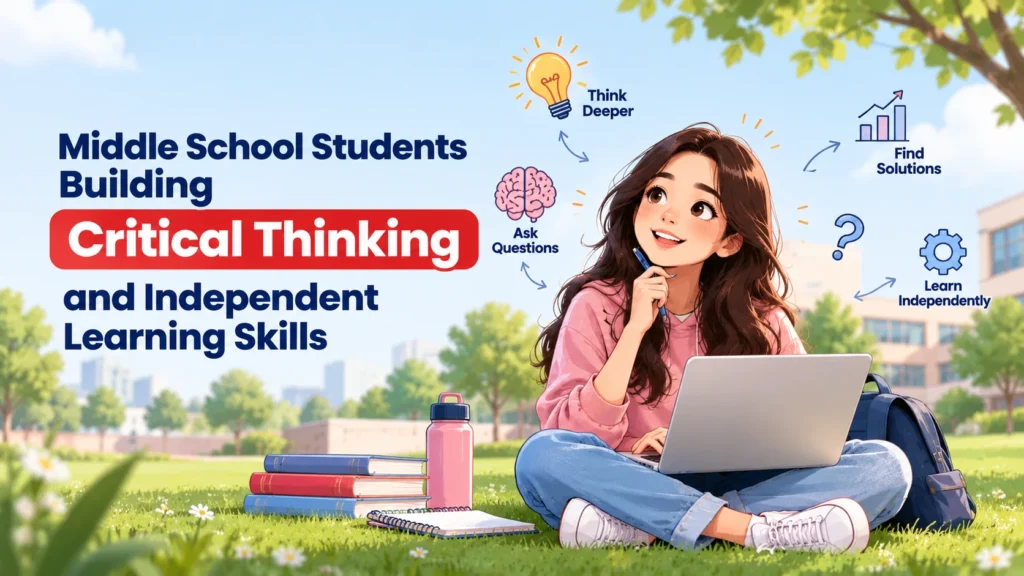
Middle school is a transition between foundational learning and the more demanding academic expectations of high school. Students begin studying subjects in greater depth and take increasing responsibility for their work.
Expanding core subjects
English Language Arts, mathematics, science, and social studies remain important. Depending on the school, students may also study technology, arts, physical education, or world languages.
Developing critical thinking
Learners may compare sources, interpret data, explain scientific processes, solve multi-step problems, and support their opinions with evidence.
Building academic responsibility
Middle school students are expected to manage assignments, prepare for assessments, organise study materials, and meet deadlines. These habits become especially important when coursework becomes more complex.
Exploring individual interests
Electives and practical activities can help students discover strengths in areas such as creative arts, technology, communication, or scientific inquiry.
Parents can support this transition by helping children develop consistent study routines while gradually encouraging them to plan and complete work more independently.
2.3 High School: Preparing for Future Pathways

High school commonly covers Grades 9–12 in the United States. It is an important stage because students work towards graduation while exploring possible pathways into university, vocational education, or employment.
The subjects, credit requirements, and available electives depend on the school and the diploma programme.
Understanding Grades 9–12
The high school years generally involve increasingly advanced coursework. Students build subject knowledge, strengthen academic writing and research skills, and learn to manage longer assignments.
Some schools provide opportunities to take advanced courses or specialised electives. Availability varies, so parents should review the programme’s course catalogue rather than assume that every subject is offered.
Exploring core subjects and electives
Core subjects often include English Language Arts, mathematics, science, and social studies. Depending on the programme, students may also study languages, arts, technology, computer science, or other electives.
Electives can help students explore interests before making decisions about higher education. However, students must balance personal preferences with the required courses and credits for graduation.
Understanding GPA and academic performance
GPA, or Grade Point Average, is a numerical summary of academic performance based on grades earned in courses. The method used to calculate it can vary by school.
Some schools use a four-point scale, while others may use weighted calculations for particular courses. Parents should check the school’s grading policy before interpreting a GPA or comparing it with results from another education system.
Preparing for graduation and college readiness
Students need to complete the required coursework and meet the relevant graduation criteria. Depending on the school, these may include specific credits, subject requirements, assessments, or other conditions.
College readiness can also involve developing research skills, preparing application documents, exploring university entry requirements, and understanding any additional tests required by the intended institution.
An American curriculum can provide a useful academic framework, but university admission is not automatic. Each university and course may have separate eligibility requirements.
3. Subjects and Learning Pathways
One of the defining features of the American curriculum is the opportunity to study a broad range of subjects. Students build knowledge across core academic areas while, where the programme permits, exploring electives connected to their interests.
3.1 Understanding the Core Subjects
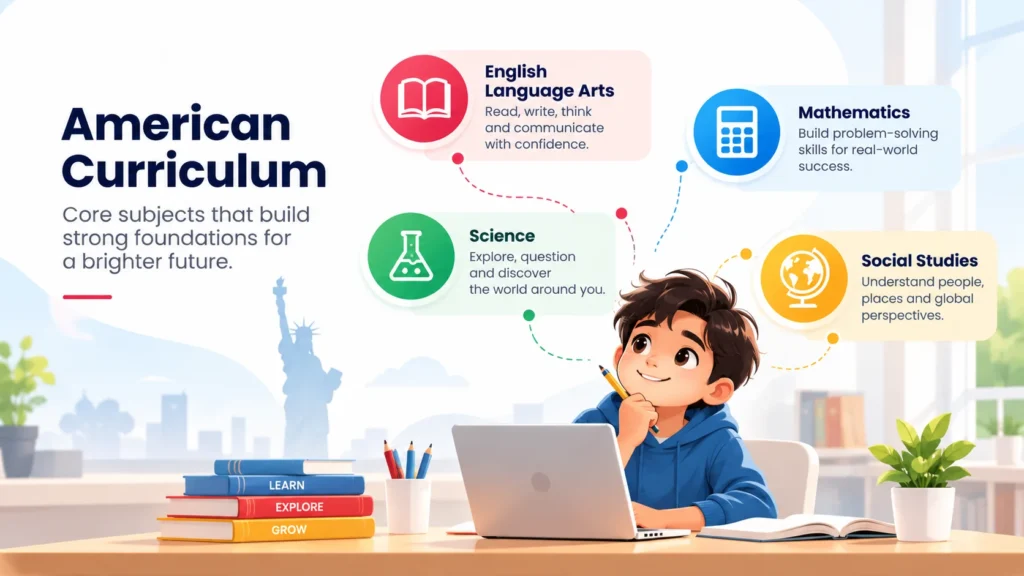
English Language Arts
English Language Arts develops reading comprehension, writing, vocabulary, grammar, communication, and literary analysis. Students may interpret texts, write essays, conduct research, and present arguments supported by evidence.
These skills are useful across subjects because students need to understand instructions, communicate ideas clearly, and explain their reasoning.
Mathematics
Mathematics progresses from foundational number skills to more advanced areas such as algebra, geometry, statistics, and other higher-level topics. The sequence depends on the student’s grade, previous coursework, and school requirements.
A strong mathematical foundation helps students approach unfamiliar problems, recognise patterns, interpret information, and make logical decisions.
Science
Science education may include biology, chemistry, physics, earth science, and other subjects, depending on the grade and programme. Students learn scientific concepts and may develop skills in observation, investigation, data interpretation, and evidence-based reasoning.
Social Studies
Social studies can include history, geography, civics, economics, and the study of societies. Students learn how communities function, how historical events shape the present, and how people and institutions interact.
3.2 Exploring Electives, Arts, and World Languages
Electives give students opportunities to explore subjects beyond the core academic requirements. Depending on the school, these may include:
- Visual arts, music, and creative expression
- Computer science, coding, and technology
- World languages
- Business, economics, or entrepreneurship
- Additional humanities or social science subjects
Electives can help students discover interests and develop a broader understanding of possible career paths. However, the availability of specific subjects should always be confirmed with the school.
3.3 Understanding Credits and Building a Balanced Academic Plan
High school students may need to complete credits across required subjects and approved electives. A balanced academic plan helps them meet these requirements while keeping future options open.
Parents and students should consider four factors when selecting courses:
- Graduation requirements: Identify the compulsory subjects and credits required by the programme.
- Academic strengths: Consider the subjects in which the student performs well and areas that need further support.
- Future interests: Explore subjects relevant to possible university courses or career directions.
- Workload: Choose a manageable combination of courses that allows enough time for assignments, revision, and other responsibilities.
For example, a student interested in computer science may wish to prioritise mathematics and relevant technology courses, provided these fit the programme’s requirements. A student interested in humanities may explore history, writing, social sciences, or languages.
These are planning examples rather than guaranteed subject combinations. The available courses and their prerequisites must be confirmed with the school.
4. Assessments, Grades, and Academic Progress
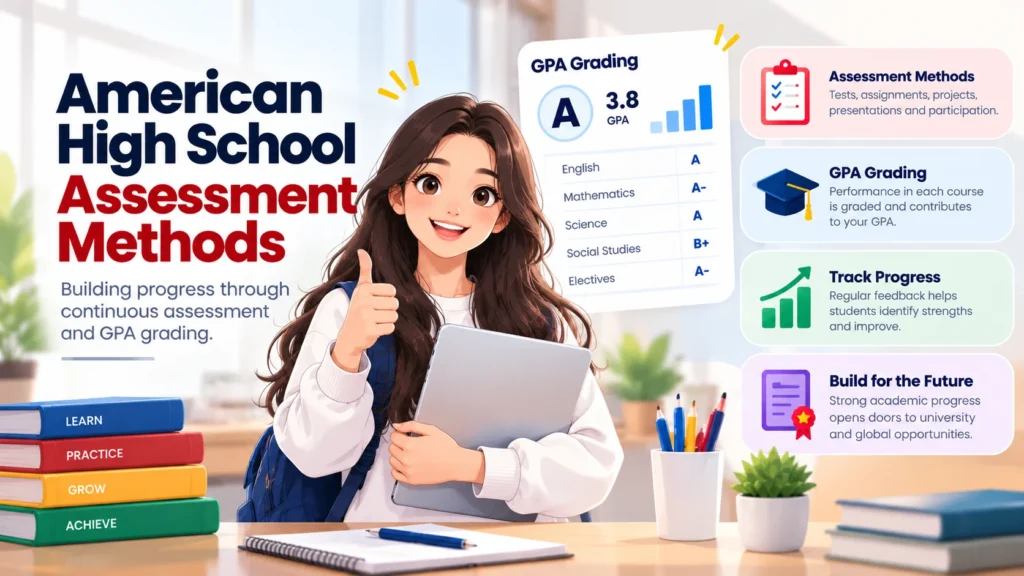
Assessment is an important part of the American curriculum. It helps teachers understand what students have learned, identify areas that require attention, and evaluate progress towards academic goals.
4.1 How Is Student Performance Evaluated?
American curriculum programmes may use a combination of assessment methods rather than relying on one final examination.
| Assessment Type | What It Helps Evaluate |
| Assignments | Understanding of concepts and ability to apply learning |
| Quizzes and tests | Recall, comprehension, and subject knowledge |
| Projects | Research, planning, creativity, and practical application |
| Presentations | Communication, organisation, and explanation of ideas |
| Class participation | Engagement, discussion, and contribution to learning |
| Examinations | Understanding of course content across a wider range of topics |
Not every school uses all these methods, and their contribution to final grades varies. Parents should review the assessment policy of the specific programme.
4.2 What Is GPA and How Is It Calculated?
GPA stands for Grade Point Average. It summarises a student’s academic performance using the grading system adopted by the school.
In a common four-point system, letter grades are converted into grade points. The points earned across courses are then used to calculate an average. Some schools use weighted GPAs for advanced courses, while others follow different methods.
A simplified illustration is shown below. This is an example only, not a universal grading scale.
| Letter Grade | Illustrative Grade Point |
| A | 4.0 |
| B | 3.0 |
| C | 2.0 |
| D | 1.0 |
| F | 0.0 |
Actual grade boundaries, grade-point values, and calculation methods vary. A student’s GPA should therefore be interpreted using the official grading policy of their school.
A GPA is one measure of academic performance, not a complete description of a student’s abilities. Course selection, improvement over time, projects, interests, and other factors may also matter when evaluating academic development.
4.3 Understanding High School Credits and Graduation Requirements
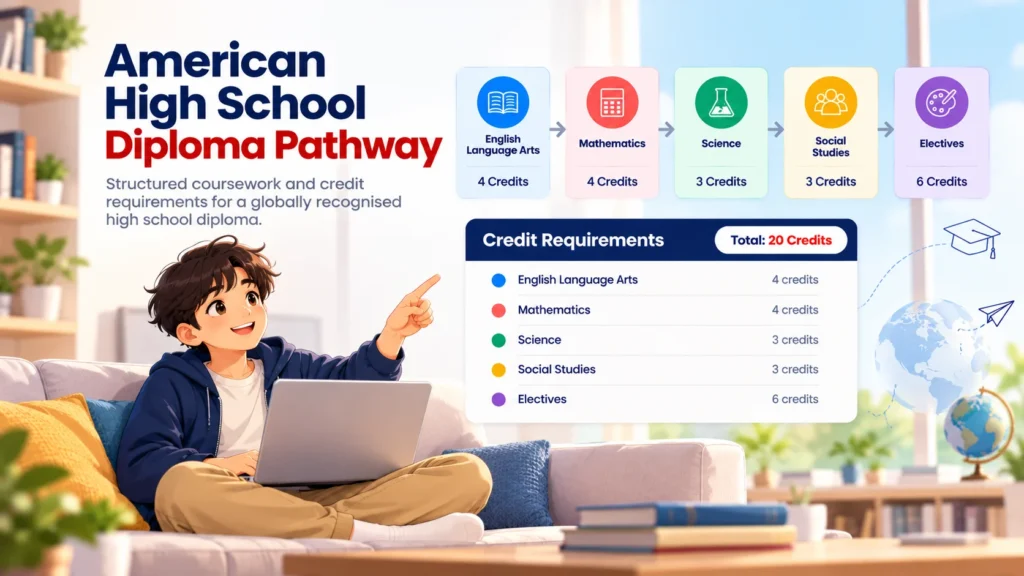
Credits generally represent the successful completion of coursework. A high school may require students to earn credits in English, mathematics, science, social studies, and other areas before graduating.
Requirements differ between states, schools, and diploma programmes. Online schools may also follow specific academic and assessment policies.
Before enrolling, parents should ask:
- How many credits are required for graduation?
- Which subjects are compulsory?
- How are transferred credits evaluated?
- What happens if a student needs to repeat or complete a course?
- How are assessments, grades, and progress reports shared?
- What certificate or diploma is awarded after successful completion?
Clear answers to these questions help families understand the academic commitment and plan the student’s progression.
4.4 How Students Can Improve Academic Progress
Consistent habits can make a significant difference to student learning. Useful strategies include:
- Setting a regular study timetable.
- Reviewing class notes after lessons.
- Breaking large assignments into smaller tasks.
- Asking teachers for clarification when concepts are difficult.
- Practising with questions and applying concepts to examples.
- Reviewing feedback instead of focusing only on the final grade.
- Tracking upcoming assessments and assignment deadlines.
Parents can encourage these habits without taking over the learning process. The goal is to help students become more organised, confident, and independent over time.
5. The American High School Diploma
5.1 What Is an American High School Diploma?
An American High School Diploma is a school-leaving credential generally awarded after a student completes the required high school coursework and meets the applicable graduation criteria.
In a typical US school structure, high school covers Grades 9–12. However, diploma programmes outside the United States may organise their course schedules, duration, and eligibility conditions differently.
The phrase American High School Diploma alone does not establish that two programmes have identical academic requirements or accreditation status. Parents should understand the specific diploma being offered, the institution responsible for awarding it, and the conditions attached to it.
5.2 Understanding Diploma Requirements and Credit Completion
Many American high school programmes use a credit-based structure. Students complete required subjects and electives, earn the necessary credits, and satisfy other programme conditions.
Before choosing a diploma pathway, confirm:
- The awarding institution’s name and status.
- The required number and distribution of credits.
- The programme’s entry requirements and expected duration.
- The assessment methods and progression rules.
- Whether previous coursework can be transferred.
- Whether the diploma is issued directly by the school or through a partner institution.
These details matter because a diploma’s title does not, by itself, explain its academic framework or recognition.
5.3 How Electives Support Individual Learning Goals
Electives can allow students to explore interests alongside required coursework. Depending on the programme, these subjects may help students develop skills in technology, the arts, languages, business, or other fields.
A well-planned course selection should balance three priorities: meeting graduation requirements, maintaining a manageable workload, and exploring subjects that support future goals.
Students should avoid selecting courses solely because they sound interesting or appear useful for a particular career. They should first confirm that the subjects count towards the relevant diploma and meet any required prerequisites.
5.4 What Parents Should Know About Diploma Recognition
Recognition is one of the most important factors to investigate before selecting an international school or diploma pathway.
Universities set their own admission policies. They may consider the awarding institution, academic transcripts, subject prerequisites, grades, English-language proficiency, entrance tests, and other application requirements.
A diploma that is accepted by one university or for one programme may not automatically meet the requirements of another. This is particularly important for regulated or specialised courses.
Parents should contact the intended universities or consult their official admission policies before making decisions based on claims of global recognition. Where necessary, they should request written confirmation of the diploma’s status and the relevant awarding institution.
For programme-specific details, review the K12 ONLINE SCHOOLS American Curriculum page and ask the school’s academic team to clarify the applicable diploma pathway.
6. Skills Developed Through the American Curriculum

Academic knowledge is only one part of a student’s education. Learning activities can also help students develop transferable skills that support further study, personal development, and future work.
6.1 Critical Thinking and Problem-Solving
Critical thinking involves examining information, questioning assumptions, comparing evidence, and reaching reasoned conclusions. Students may practise these skills through reading, mathematics, scientific investigations, research, and classroom discussions.
Problem-solving encourages learners to identify a challenge, consider possible approaches, test ideas, and evaluate the results. These skills become valuable when students face unfamiliar academic or practical situations.
6.2 Creativity and Independent Thinking
Creative thinking allows students to explore different approaches instead of assuming that every problem has only one possible answer. Writing, art, project work, research, and design activities can provide opportunities to develop original ideas.
Independent thinking also means learning to make decisions, explain choices, and take responsibility for academic work. Students still need guidance, but gradually developing autonomy can prepare them for the demands of higher education.
6.3 Communication and Collaboration
Students need to communicate clearly, listen to others, share ideas, and respond constructively to different viewpoints. Presentations, group projects, discussions, and written assignments can help build these skills.
Collaboration also teaches learners to divide responsibilities, manage disagreements, and work towards shared outcomes.
6.4 Connecting Academic Knowledge with Real-World Applications
When students connect lessons with practical examples, they can better understand why a concept matters. Mathematics may help them interpret budgets and data, science can explain everyday phenomena, and social studies can deepen their understanding of communities and public institutions.
The strength of this approach depends on how the school designs its lessons and learning activities. Parents can ask how projects, practical tasks, and feedback are incorporated into the programme.
7. Understanding Online American Education
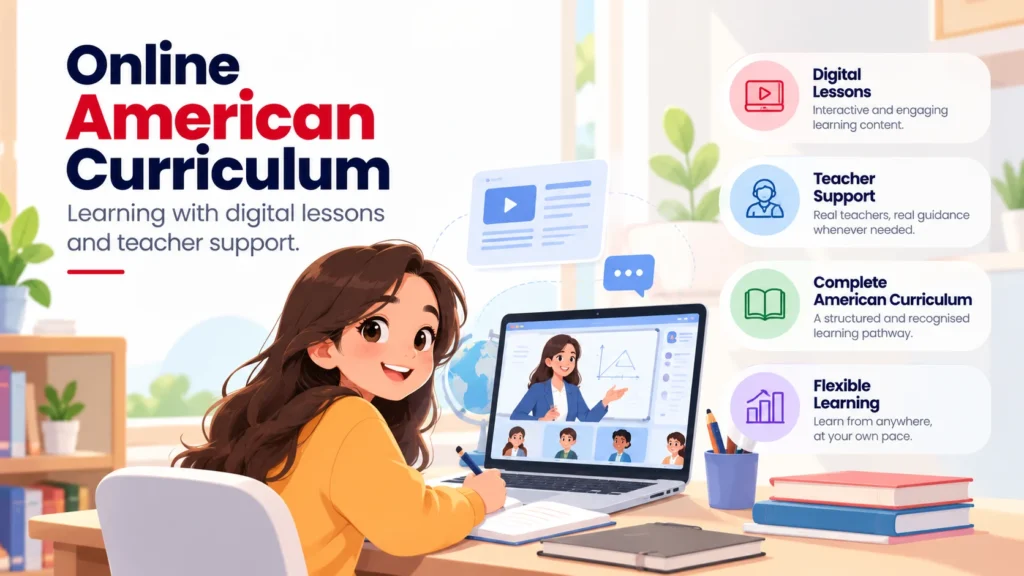
Online schooling can make an American curriculum accessible to students who need a different learning arrangement from a traditional physical school. However, the quality of the experience depends on the teaching model, academic structure, student support, and assessment process.
7.1 How Do Online American Curriculum Classes Work?
Online American curriculum programmes may combine live lessons, recorded resources, digital assignments, teacher feedback, and online assessments.
In live classes, students can interact with teachers, ask questions, discuss concepts, and participate in activities. Recorded lessons or digital resources may allow them to revisit difficult topics and revise at a suitable pace.
The exact format varies. Some programmes require students to attend scheduled classes, while others offer greater flexibility through recorded or self-paced learning.
Parents should check the timetable, attendance requirements, expected independent study time, and technology needed before choosing a programme.
7.2 Live Classes, Teacher Support, and Student Engagement
A strong online learning experience requires more than access to digital content. Students need clear explanations, opportunities to ask questions, timely feedback, and guidance when they encounter difficulties.
When comparing online schools, ask whether the programme includes:
- Live classes with subject teachers.
- Scheduled doubt-clearing or academic support sessions.
- Regular feedback on assignments and assessments.
- Access to recorded lessons or learning resources.
- Progress reports for students and parents.
- A defined process for addressing academic concerns.
Parents should confirm which of these features are included in the specific programme rather than assuming that all online schools provide the same support.
7.3 Digital Learning Tools and Academic Resources
Digital learning platforms can organise lessons, assignments, schedules, learning materials, and progress records in one place. Depending on the platform, students may also have access to quizzes, interactive exercises, discussion tools, and recorded sessions.
These resources can help students keep track of their responsibilities and revisit topics when needed.
However, technology should support learning rather than replace effective teaching. A useful platform is one that students can navigate easily and that helps teachers and parents understand academic progress.
7.4 What Should Parents Consider Before Choosing an Online American School?
Before enrolling, evaluate the programme across several areas.
| Factor | What Parents Should Check |
| Curriculum | Which academic standards and course framework does the school follow? |
| Grade availability | Which grades are currently offered? |
| Teaching | Are lessons live, recorded, self-paced, or a combination? |
| Assessment | How are students evaluated and how often is feedback provided? |
| Academic support | How can students receive help when they struggle? |
| Diploma | Which institution awards the final credential? |
| Accreditation | What is the institution’s current accreditation or candidacy status? |
| University pathways | What additional admission requirements may apply? |
| Technology | What devices, internet access, and digital tools are needed? |
These questions help parents look beyond marketing claims and understand what their child will actually experience.
8. Exploring the American Curriculum at K12 ONLINE SCHOOLS
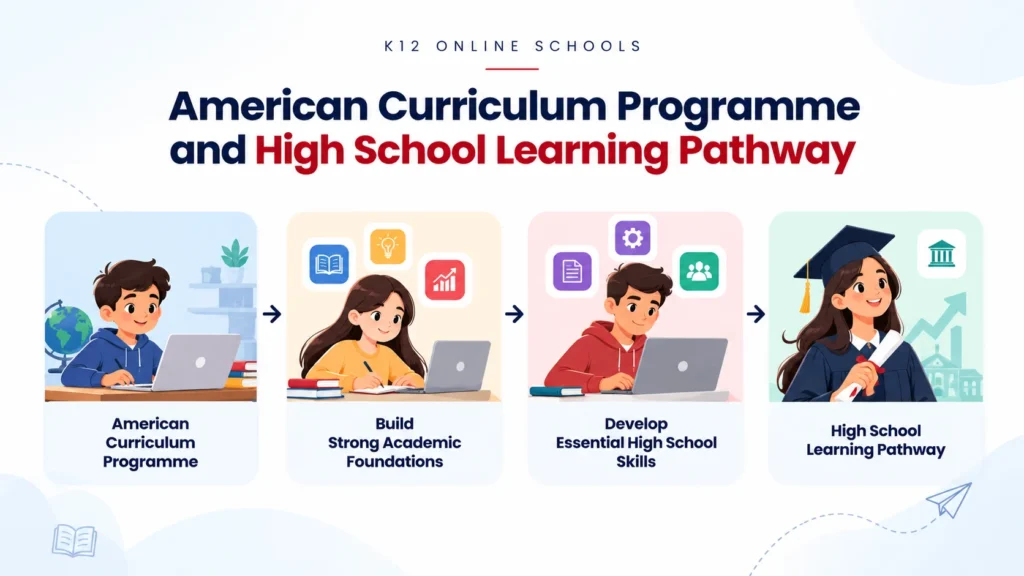
K12 ONLINE SCHOOLS publishes an American Curriculum programme designed around academic development, subject learning, and preparation for a High School Diploma. Its programme page lists English Language Arts, Mathematics, Science, Social Studies, Foreign Languages, Arts and Humanities, and Technology and Computer Science among its subject areas. It also describes project-based learning, interactive lessons, and technology-supported learning.
K12 Schools
Parents should review the published details and confirm the current grade availability, course options, assessment requirements, and diploma arrangements with the academic team before enrolling.
8.1 Understanding the American Curriculum Programme
The American curriculum page presents a learning pathway intended to develop academic skills, creative thinking, and a broader perspective. Its stated approach includes a combination of core academic subjects and opportunities for students to explore areas of interest.
K12 Schools
When exploring the programme, parents should ask for a current subject list and grade-wise academic plan. These documents can help them understand how the curriculum progresses and which courses are available to their child.
Explore the K12 ONLINE SCHOOLS American Curriculum programme for the school’s published overview.
8.2 Exploring the High School Diploma Pathway
For students considering an American High School Diploma, it is important to understand the specific programme structure before making an enrolment decision.
Ask the academic team to clarify the awarding institution, credit requirements, assessment methods, entry criteria, and expected duration. If the student has completed coursework elsewhere, also ask whether previous credits can be evaluated for transfer.
These details help families understand the student’s route from enrolment to graduation and avoid confusion about the credential awarded at the end.
8.3 Understanding Online Learning and Academic Support
When assessing K12 ONLINE SCHOOLS, parents should request information about the learning platform, class schedule, teacher interaction, assignment feedback, and academic progress reporting for the selected American curriculum programme.
It is also worth understanding how students receive help with challenging subjects and how parents can monitor progress. A clear support structure can make it easier for learners to manage academic responsibilities while developing independence.
8.4 Choosing a Programme Based on Academic Goals
The right programme should reflect the student’s current academic level, learning preferences, future plans, and support needs.
Before selecting a pathway, consider the following:
- Which grade or programme level is appropriate for the student?
- Which subjects are available and required?
- What are the entry and progression criteria?
- What qualification will the student receive?
- Do the student’s intended universities accept that qualification, subject to their admission requirements?
- What support is available if the student needs additional help?
A conversation with the academic team can help parents clarify these points before committing to a programme.
8.5 How to Explore the Programme and Book a Demo
Parents can begin by reviewing the American Curriculum page and requesting current programme information from K12 ONLINE SCHOOLS.
Before booking a demo, prepare questions about the course structure, teaching format, assessment policy, subject choices, and diploma-awarding arrangements. A demo can help families understand the learning experience, while written programme documentation can clarify academic requirements and eligibility.
Considering the American curriculum for your child? Explore the programme, discuss your child’s academic goals with the school’s team, and confirm the details that matter before making a decision.
Explore the American Curriculum at K12 ONLINE SCHOOLS
9. Frequently Asked Questions
Q1. What is the American curriculum?
Answer: The American curriculum is an educational approach based on academic frameworks and learning standards used in the United States. It commonly includes English Language Arts, Mathematics, Science, and Social Studies, alongside opportunities for electives and broader skill development. The exact curriculum and assessment structure depend on the school.
Q2. What are the different grade levels in American schools?
Answer: American schools are commonly organised into elementary school, middle school, and high school. High school generally covers Grades 9–12, while the grade ranges for elementary and middle school can vary. Parents should check the specific structure followed by the school they are considering.
Q3. How does the American curriculum differ from the Cambridge curriculum?
Answer: The American curriculum commonly uses grade progression, coursework, and, in high school, credit-based graduation requirements. The Cambridge pathway follows its own stages and qualifications, including programmes such as IGCSE and A Levels. Assessment methods, subject choices, and progression requirements differ, so parents should compare the actual programmes rather than relying only on the curriculum names.
Q4. What is a US High School Diploma?
Answer: A US High School Diploma is generally awarded after a student completes the required high school coursework and meets the applicable graduation criteria. Requirements depend on the school and programme. Parents should verify the awarding institution, credit requirements, and recognition of the specific diploma.
Q5. How do credits and GPA work in American high schools?
Answer: Credits usually record the successful completion of courses and may be required across specific subject areas for graduation. GPA, or Grade Point Average, summarises academic performance using the school’s grading system. Credit requirements and GPA calculations vary, so students should follow their programme’s official policies.
Q6. Can students complete an American High School Diploma online?
Answer: Yes, some schools and education providers offer online American High School Diploma pathways. However, programme duration, eligibility, course requirements, assessments, and awarding arrangements differ. Parents should confirm these details and verify whether the credential meets the requirements of the student’s intended university or future pathway.
Q7. What should parents consider before choosing an American curriculum school?
Answer: Parents should review the curriculum framework, available grades, subject options, teaching format, assessment methods, academic support, total costs, and graduation requirements. They should also verify the awarding institution’s status and check the admission policies of any universities the student may wish to attend.
Conclusion: Choosing the Right American Curriculum Pathway
The American curriculum can offer students a broad academic experience that combines core subjects, opportunities to explore interests, and the development of skills such as critical thinking, communication, and independent learning.
Understanding grade levels, subject choices, assessment methods, GPA, credits, and diploma requirements helps parents make more informed decisions. Equally important is recognising that schools can differ in their curriculum delivery, available courses, academic support, and qualifications.
Before selecting an online American curriculum programme, review its official documentation, confirm the diploma-awarding arrangements, and check the requirements of the universities or institutions your child may wish to pursue.
With the right information and a clear understanding of your child’s goals, you can choose an educational pathway that supports both academic progress and future opportunities.
Stay connected with K12 ONLINE SCHOOLS for more insights into international curricula, online learning, and educational pathways for students. Explore the K12 Schools Instagram profile for more learning-related updates.
Comments are closed