
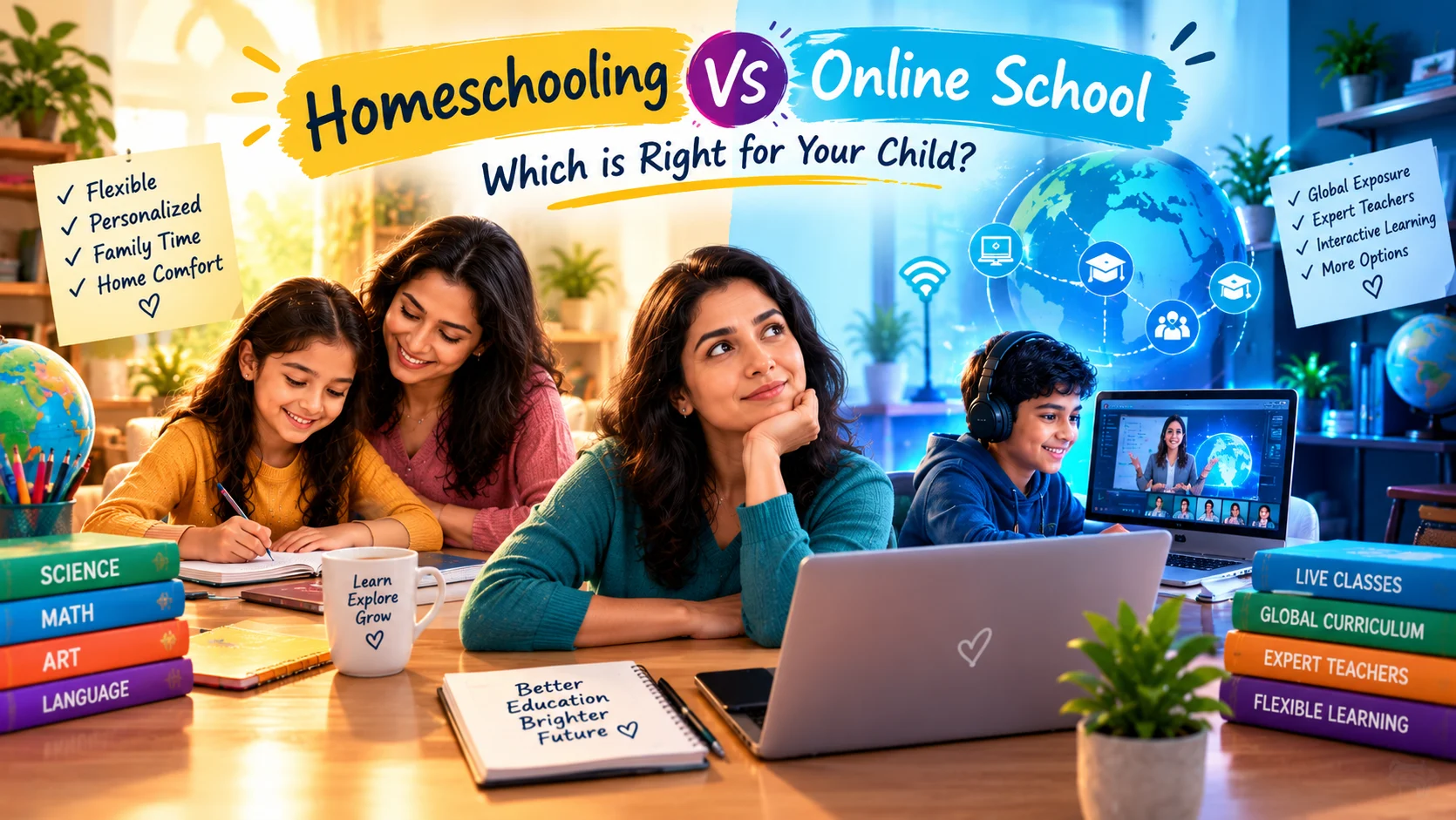
Homeschooling vs Online School: What’s the Real Difference?
At first glance, they look almost identical.
Your child studies from home. There’s a laptop. There’s flexibility.
But here’s the part many parents discover only after starting:
Homeschooling and online schooling put very different responsibilities on the parent.
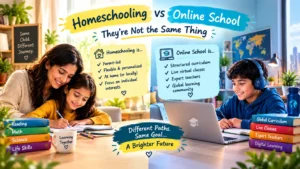
With homeschooling, you run the education — choosing the curriculum, planning lessons and tracking progress.
With online school, the school runs the education — teachers teach, the school sets the curriculum and students follow an organised academic programme.
So if you’re comparing homeschooling vs online school, don’t just ask which one is more flexible.
Ask:
Who do I want responsible for my child’s education every day?
That question usually makes the choice much clearer.
Homeschooling vs Online School: A Quick Comparison
| Homeschooling | Online School | |
| Teaching | Parent-led | Teacher-led |
| Curriculum | Parent chooses | School provides |
| Schedule | Highly flexible | Structured |
| Progress tracking | Parent-managed | School-managed |
| Social activities | Parent arranges | School may provide |
| Accreditation | Depends on programme | Depends on school |
| Parent involvement | High | Varies by age |
| Diploma | Depends on pathway | School provides, if applicable |
Neither model is automatically better.
The right choice depends on your child’s needs and your family’s capacity.
When Does Homeschooling Make Sense?

Homeschooling can be a great option when parents genuinely want to take an active teaching role.
It offers:
- Maximum flexibility around schedules and travel
- Freedom to choose a homeschool curriculum for kids
- The ability to adjust learning around a child’s pace and interests
- More control over teaching methods and daily routines
For some families, that’s exactly what they want.
But there’s a catch people sometimes underestimate:
Homeschooling is not simply “school at home.”
You’re also the planner, teacher, researcher, assessor and progress tracker.
If you’re already juggling work and family responsibilities, that can become a lot.
When Does Online School Make More Sense?
An online school gives families the flexibility of learning from home without making the parent the teacher.

Students can have:
- Live classes with teachers
- A structured academic timetable
- Assignments and assessments
- Regular progress tracking
- A defined curriculum
- Opportunities for extracurricular activities
For parents asking, “Is online school better than homeschooling?”, this is often the deciding factor:
How much of the teaching responsibility do you actually want to carry?
If you want professional teachers to handle instruction while you remain involved as a parent, online school may be the more practical model.
What About NRI & Expat Families?
This is where online schooling can become particularly useful.
For an Indian family living in Dubai, Singapore, Australia, the UAE or elsewhere, changing countries can also mean navigating completely different education systems.
An online school for NRI students can provide continuity while the family lives abroad.
Parents may specifically look for:
- Best online school for Indian students abroad
- An accredited online school with Indian curriculum
- Cambridge or American curriculum options
- A school that can be accessed across locations
For Indian expat families, an online homeschool for Indian expats can sound attractive because of the flexibility. But parents should first understand whether they actually want parent-led homeschooling or a structured online school.
What If Your Child Needs More Than a Screen?
This is one of the biggest concerns with online education:
“Will my child actually get hands-on experiences?”
That’s where a hybrid experiential learning online school model becomes interesting.
K12 Schools’ Hybrid Experiential Learning Centre (ELC) combines online academic learning with in-person experiential activities.
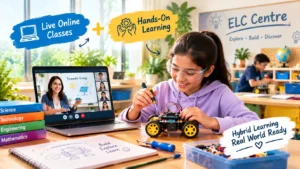
The idea is simple:
Learn online → experience it in the real world.
This can include practical activities, collaborative projects and experiential learning rather than making education entirely screen-based.
For parents looking for an online school with hands-on learning, this type of hybrid model can offer a middle ground between traditional schooling and fully home-based learning.
What About Cambridge, American or Indian Curriculum?

Curriculum can completely change the decision.
For example:
- Families wanting an international pathway may consider Cambridge curriculum online school vs homeschool.
- Indian families may prefer an accredited online school with Indian curriculum.
- Families looking for a U.S.-oriented pathway may explore American curriculum online homeschool options.
Don’t choose a curriculum simply because it sounds international.
Look at where your child may study next, university requirements, transferability and the family’s long-term plans.
Homeschool vs Online School: Which Is Better for High School?
The decision becomes more important as children get older.
For online school vs homeschool for high school, parents should consider:
- Who will teach advanced subjects?
- Who tracks credits and assessments?
- What documentation will universities need?
- Does the child need external accountability?
- How independent is the student?
Some families also consider switching from homeschool to online school when senior-level subjects become more specialised or when managing academic documentation becomes difficult.
That’s not a failure of homeschooling.
Sometimes the family’s needs simply change.
Can Homeschooled Students Get Into College?
Yes, but planning matters.
Universities may look at transcripts, academic rigour, testing, portfolios and other evidence depending on the institution and country.
That’s why parents should think about the post-school pathway before choosing a homeschooling or online-school model.
The same applies to questions such as how much homeschooling costs or whether a parent needs a teaching certificate — requirements and costs vary significantly by location.
So, Which One Should You Choose?
Here’s the simplest way I would look at it:
Choose homeschooling if:
- You want to lead your child’s education.
- Maximum schedule flexibility is important.
- You have the time and confidence to teach and manage learning.
Choose online school if:
- You want qualified teachers handling instruction.
- Your child benefits from structure and accountability.
- You want a defined curriculum and organised progress tracking.
- Your family needs location flexibility without taking full responsibility for teaching.
And if you’re somewhere in the middle, don’t force yourself into one box.
The best education model is ultimately the one that fits your child’s learning needs, your family’s reality and your long-term academic goals.
The question isn’t “Which model is best?”
It’s “Which model can we realistically make work well?”
Type your paragraph here
In your research, keep the homeschooling vs online school question at the forefront of your mind.
As you deliberate, consider how homeschooling vs online school fits your family’s lifestyle.
Ultimately, both homeschooling vs online school have their merits and challenges.
The topic of homeschooling vs online school often centers on teaching styles and learning environments.
Discussions about homeschooling vs online school are common among modern families.
Parents might find that the choice between homeschooling vs online school significantly shapes their child’s future.
When considering education, think about homeschooling vs online school and how each can provide different advantages.
Understanding homeschooling vs online school can greatly impact your child’s educational journey.
As you explore your options, weigh the pros and cons of homeschooling vs online school carefully.
Many parents find themselves asking, should we consider homeschooling vs online school based on our unique circumstances?
Ultimately, the debate of homeschooling vs online school hinges on the needs of the child and the family’s situation.
When considering homeschooling vs online school, it’s essential to evaluate your educational goals and how each option aligns with them.
Comments are closed