
Introduction
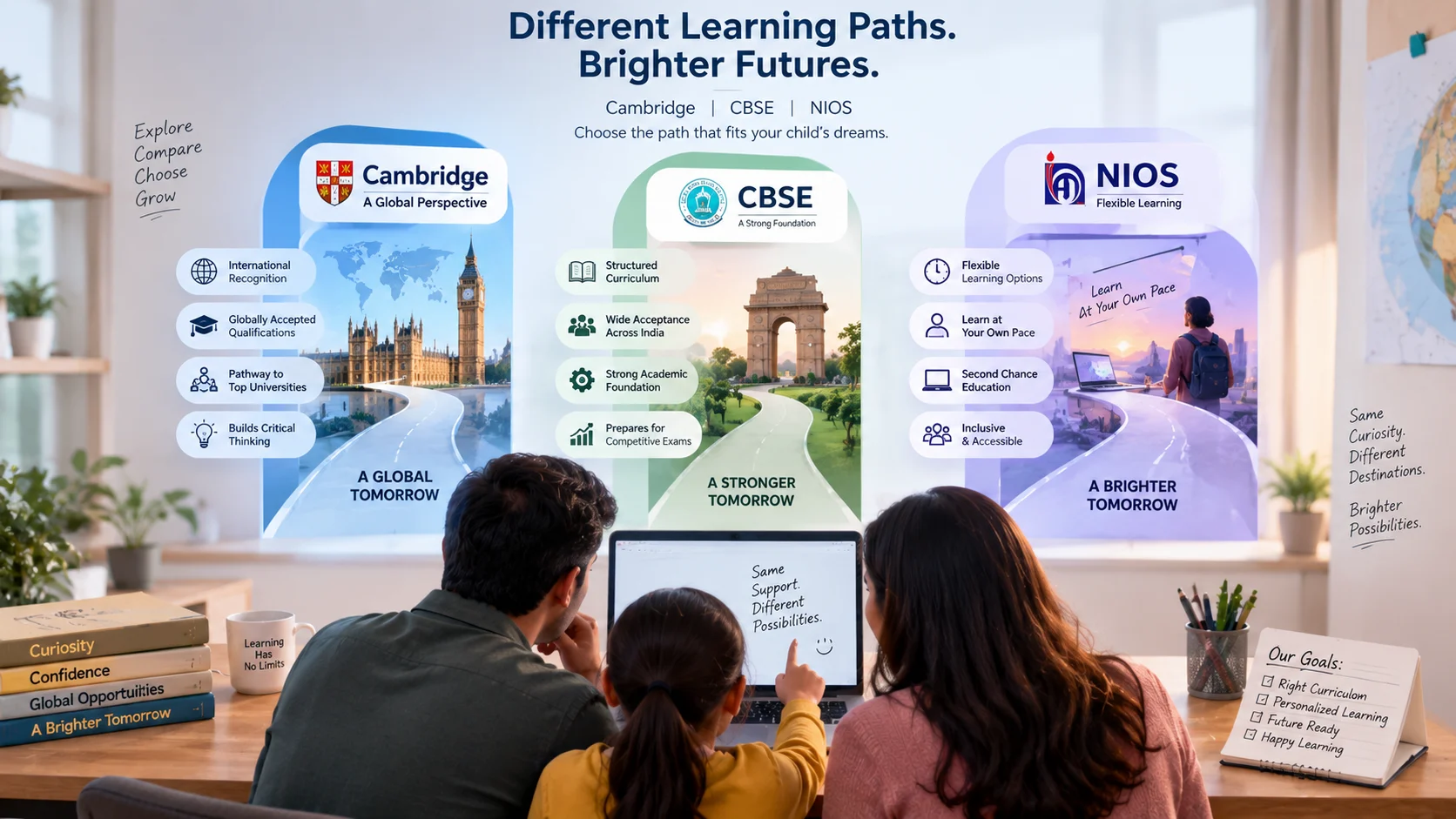
Choosing a curriculum is not just choosing what your child will study. It can influence where they can study next.
For many families, the decision between Cambridge IGCSE, CBSE, and NIOS happens too late — often when university plans, competitive exams, or an international move are already on the horizon.
The right choice depends on three things:
- Where your child may study later
- How flexible your family’s lifestyle needs to be
- How your child learns best
For an NRI family, an international student, or a child whose future location is uncertain, the decision can be even more important.
So, which curriculum is best for your child online? Let’s compare them without treating one as universally better.
What Are You Actually Choosing Between?
Although all three can lead to recognised school qualifications, they are designed for different needs.
Cambridge IGCSE
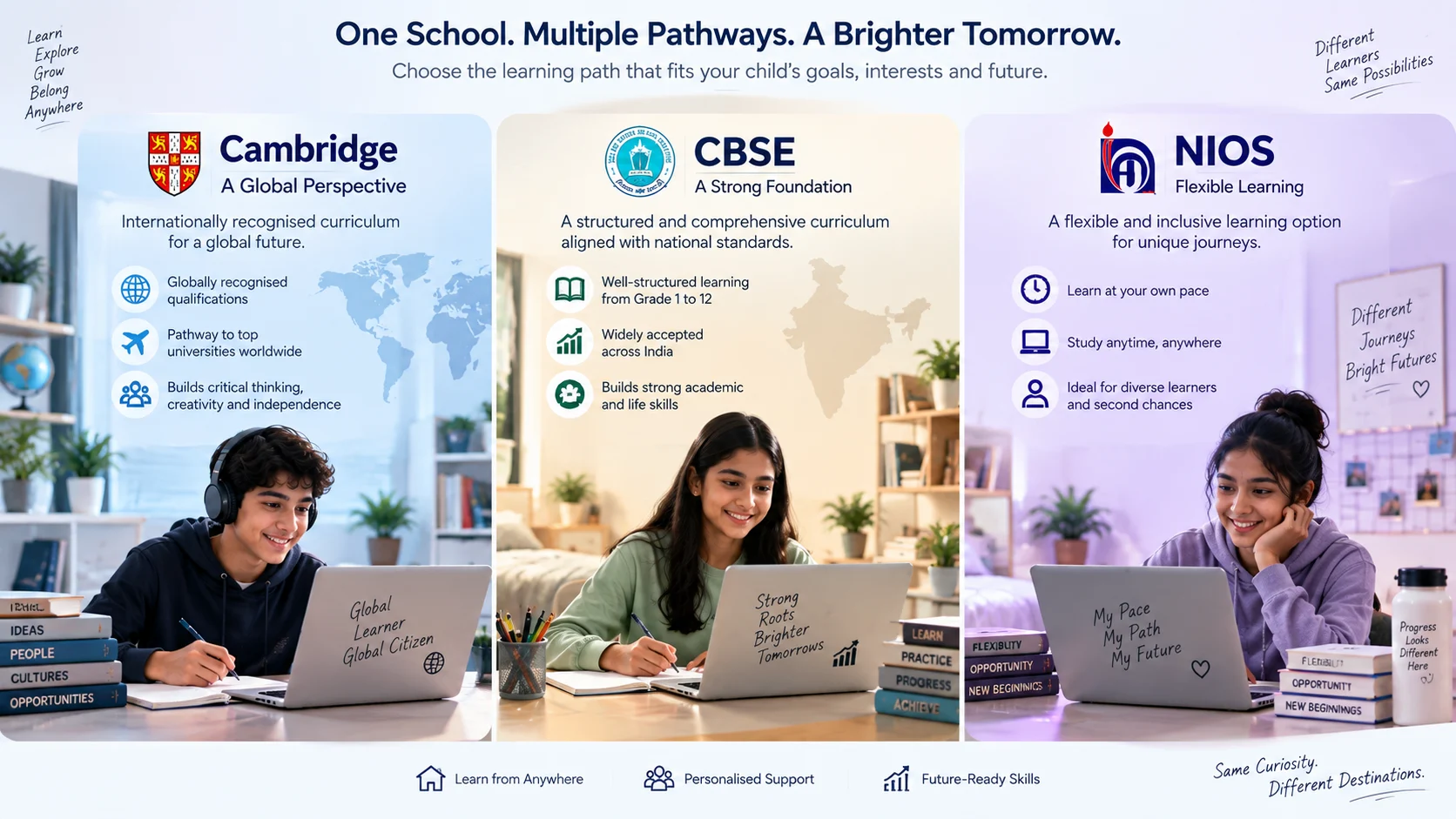
Cambridge IGCSE is an international qualification generally taken around ages 14–16. Students can then progress to Cambridge A Levels online or equivalent senior-secondary pathways.
Its biggest advantage is its international orientation. It can suit families who may move countries or are considering universities across different education systems.
The learning approach also places considerable emphasis on understanding, analysis, application, and evidence, rather than simply reproducing information.
CBSE
CBSE is India’s national school board and is particularly relevant for students planning to pursue higher education in India.
For families asking about the best board for JEE and NEET preparation, CBSE has an important practical advantage: the content of these competitive examinations overlaps significantly with the Indian school curriculum.
That makes CBSE particularly relevant when the destination is clearly India and competitive entrance exams are part of the plan.
NIOS
NIOS, or the National Institute of Open Schooling, provides a more flexible route to Indian school certification.
It can suit students who cannot or do not want to follow a conventional daily-school schedule — including some NRI families, students with demanding schedules, and learners who need greater flexibility.
The important distinction is this:
NIOS is not simply “online CBSE.” It is a separate open-schooling pathway.
Cambridge IGCSE: When Your Child’s Future Is International
Consider a family living in Dubai today, unsure whether they will be in Singapore, the UK, India, or somewhere else when their child reaches university age.

This is where a Cambridge IGCSE online school can make sense.
Cambridge can be particularly attractive when:
- Your family may relocate internationally
- Your child may apply to universities in different countries
- You want an internationally oriented curriculum
- Your child’s strengths are analytical and conceptual
- You want to progress toward Cambridge A Levels online
For NRI students, this flexibility can be valuable because the family’s eventual destination may not be known several years in advance.
However, Cambridge isn’t automatically the right answer for every student.
A child specifically targeting Indian competitive examinations may need additional planning around subject content and exam preparation.
CBSE: When India Is the Clear Destination

If your child already has a strong plan to pursue higher education in India, CBSE can be the more direct pathway.
This is especially relevant for students considering:
- JEE
- NEET
- Other Indian competitive entrance examinations
- Indian universities and colleges
The biggest strength of CBSE is alignment with India’s education and examination ecosystem.
That doesn’t mean CBSE is better than Cambridge overall.
It means that when the destination is known, alignment becomes extremely important.
For an NRI family certain that their child will return to India for university, CBSE vs Cambridge for NRI students becomes a question of destination rather than prestige.
NIOS: When Flexibility Matters Most
What if your child needs an Indian qualification but a conventional school schedule simply doesn’t work?
That’s where NIOS online school options can become relevant.
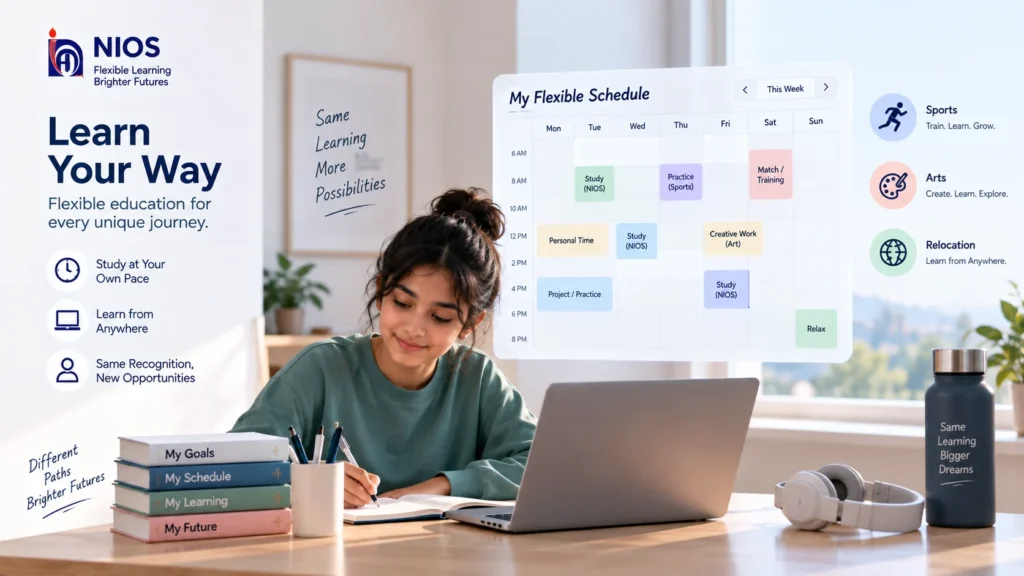
NIOS can be considered when a student needs greater flexibility because of:
- Relocation
- Sports or performing-arts commitments
- Personal circumstances
- Alternative learning arrangements
- A non-traditional study schedule
The NIOS admission process and open-schooling structure offer flexibility that conventional school systems may not.
But flexibility requires responsibility.
A student who needs constant external structure may struggle with a highly independent learning model. In such cases, families should look for a properly structured learning environment with scheduled classes, teacher support, academic monitoring, and parent visibility.
Cambridge vs NIOS: Which Is Better?
This is not really a question of which qualification is “better.”
It’s a question of what problem you are trying to solve.
| If your priority is… | Consider |
| International mobility | Cambridge |
| International university options | Cambridge |
| Indian competitive exams | CBSE |
| Indian board pathway with flexibility | NIOS |
| Non-traditional study schedule | NIOS |
| Uncertain future location | Cambridge |
| Clear India-focused academic pathway | CBSE |
For families comparing Cambridge vs NIOS, the key distinction is international orientation versus flexible Indian-board schooling.
The NEET Preparation Cambridge Curriculum Gap
This deserves special attention.
A student following Cambridge who later decides to pursue NEET may need to address differences between their school curriculum and the content expected for the entrance examination.
That does not mean Cambridge students cannot pursue medicine in India.
It means the family should identify the requirement early, rather than discovering the gap during final exam preparation.
The same principle applies to JEE.
Curriculum decisions become expensive when they are made after the destination has already been decided.
Switching Curriculum Mid-School: Is It Possible?
Yes — but it should not be treated as a simple school transfer.
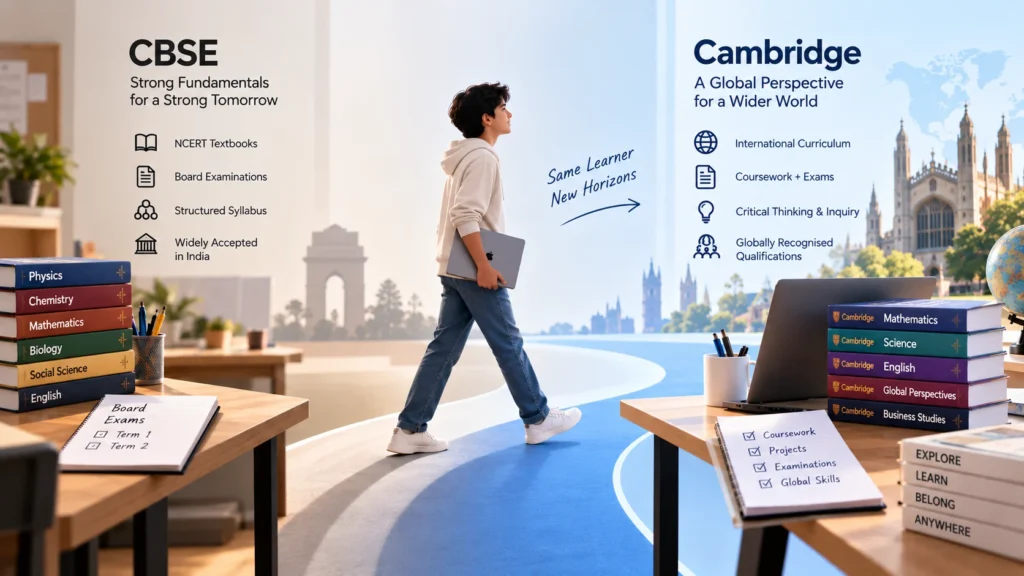
Switching from CBSE to Cambridge, or the other way around, can involve differences in:
- Subject content
- Assessment style
- Learning approach
- Examination structure
- Academic terminology
The earlier the switch is considered, the more room the student has to adapt.
For families considering switching curriculum mid-school, Grade 6–8 can often provide more breathing room than waiting until the final years of secondary education.
The same principle applies to students moving from NIOS to a more structured school environment.
Three Questions That Usually Make the Decision Clear
Before comparing school brochures, answer these three questions.
1. Where could your child go to university?
International or uncertain? Cambridge may provide a broader international pathway.
India with JEE/NEET in mind? CBSE deserves serious consideration.
India, but flexibility is essential? NIOS may fit better.
2. Could your family move countries?
If yes, think about curriculum continuity before choosing a school.
An online international school following a curriculum aligned with your child’s likely future can reduce disruption when families relocate.
3. What does your child actually need?
Ask whether your child thrives with:
- Structured classroom routines
- Flexible scheduling
- Analytical learning
- Exam-focused preparation
- Greater independence
The best curriculum is the one that fits both the destination and the learner.
What Should NRI Parents Consider?
For online school for NRI students, curriculum is only one part of the decision.
Also check:
- Whether the school is appropriately accredited or recognised
- Which grades the accreditation covers
- How examinations are conducted
- Whether classes work across your time zone
- What happens if your family relocates again
- How transcripts and qualifications are issued
- Whether the pathway fits your child’s intended university destination
Don’t choose an accredited online school K-12 simply because the word “accredited” appears on the homepage. Verify who provides the accreditation, what grades it covers, and what qualification your child actually receives.
FAQ
Is Cambridge IGCSE accepted by Indian universities?
Cambridge qualifications can be used for university applications in India, but individual institutions and courses may have specific eligibility and subject requirements. Students targeting JEE or NEET should separately plan for those examination requirements.
Can an NIOS student apply to universities abroad?
Potentially, yes, but acceptance depends on the university, country, programme, and eligibility requirements. Families should verify requirements directly with their target universities rather than assuming universal recognition.
What is the difference between CBSE and NIOS?
CBSE follows a structured school-board model, while NIOS provides an open and flexible schooling pathway. Both serve Indian education needs, but they suit different student circumstances.
Can a student switch from CBSE to Cambridge?
Yes, but switching curriculum mid-school requires careful planning. Students may need time to adjust to different content, assessment methods, and learning expectations.
Which curriculum is best for NRI students?
There is no universal answer. Cambridge may suit families seeking an internationally oriented pathway, while CBSE or NIOS may be more appropriate when the child’s future is strongly connected to Indian higher education.
Final Thoughts
Don’t choose a curriculum because it is popular. Choose it because it fits the future you are preparing your child for.
Cambridge can make sense for international mobility.
CBSE can make sense for an India-focused competitive pathway.
NIOS can make sense when flexibility is the priority.
The most important question isn’t “Which curriculum is the best?”
It’s:
“Which curriculum gives my child the right options for the life they are most likely to lead?”
Make that decision early, and changing countries, universities, or academic goals becomes much easier to manage.
Comments are closed