
Introduction
Every online school’s website seems to say the same thing:
Accredited. Flexible. Expert teachers. Personalised learning. Global education.
After visiting six school websites, it can be hard to tell them apart.
So how do you actually find the best online schools k 12 for your child?
The answer isn’t another ranking list.
The right school depends on your child’s age, learning needs, curriculum, location, budget, and future university plans.
Here’s a practical checklist to help you compare schools before making a decision.
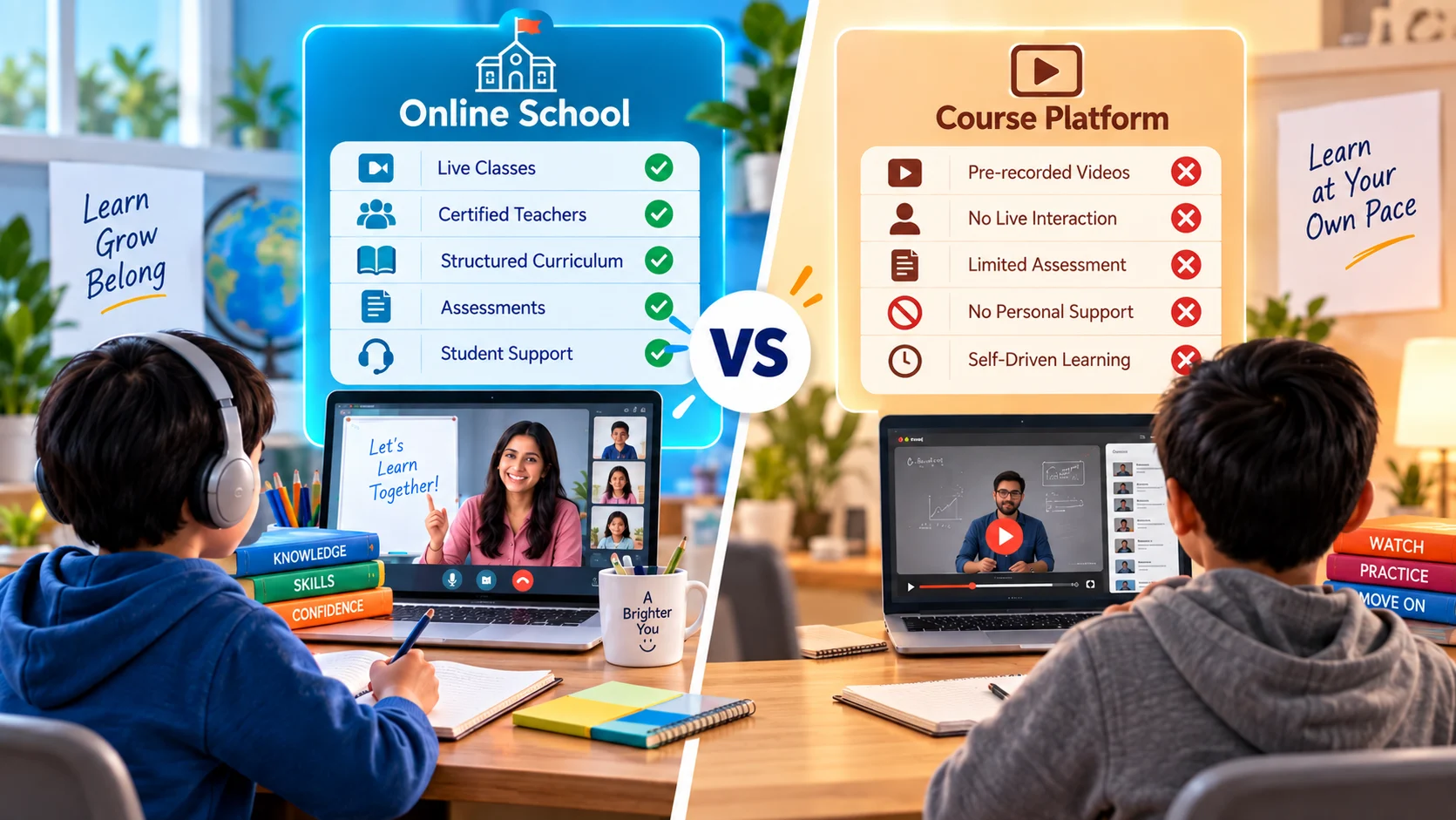
What Separates a Real Online School From a Course Platform?
This is the first thing parents should check.
A course platform may provide lessons and videos. A genuine online school should provide a more complete schooling experience — including teachers, structured learning, assessment, student support, and appropriate academic documentation.
1. Check the Accreditation
“Accredited” sounds reassuring, but don’t stop at the logo on the website.
Ask:
- Who accredited the school?
- Is the accreditation current?
- What programme or qualification does it cover?
- Can you verify it through the accrediting organisation?
- Is it relevant to the country where your child plans to study next?
Knowing how to verify online school accreditation can save parents from making an expensive mistake.
Don’t just ask whether a school is accredited. Ask what exactly is accredited and by whom.
2. Look for Real-Time Teacher Interaction
There’s a big difference between an online school with live classes and a platform where students mainly watch recorded lessons.
Live classes allow students to:
- Ask questions in real time
- Interact with teachers
- Participate in discussions
- Receive immediate clarification
- Follow a structured school routine
Ask the school:
“Can I observe a real live class before enrolling?”
That’s much more useful than watching a promotional video.
3. Choose a Curriculum That Fits Your Child’s Future

Curriculum choice becomes especially important for international families.
A child planning for universities in the UK may need a different pathway from a student preparing for Indian entrance examinations or applying to U.S. universities.
A multi-curriculum online school may offer pathways such as:
- Cambridge
- Indian curriculum
- American curriculum
The important question isn’t simply which curriculum is best?
It’s:
Which curriculum makes sense for where my child is going next?
4. Don’t Ignore the Technology

Good educational technology should do more than make classes look modern.
Look for an online school with AI learning tracking that can help teachers and parents understand:
- What the student has completed
- Where the student is struggling
- How their learning is progressing
- Where additional support may be needed
A useful online school with parent dashboard should also give parents clear visibility without requiring them to become teachers themselves.
Ask for a live demonstration, not just screenshots.
5. Check What Happens Beyond Academics
School isn’t only about completing textbooks.
Ask whether students have opportunities for:
- Coding
- Debate
- Art
- Drama
- Sports or wellness activities
- Student clubs
- Leadership activities
- Projects and collaborative learning
The strongest online programmes try to create opportunities for students to interact, create, collaborate and explore, rather than spending every hour simply watching a screen.
How to Choose an Online School for NRI & Expat Families

For families living outside India or moving between countries, the decision becomes more complicated.
An international online school for Indian students abroad can provide continuity when a family relocates.
Parents should consider:
- Curriculum compatibility
- Recognition of the qualification
- Teacher availability across time zones
- Transfer and documentation requirements
- University pathway
- Student support
- Flexibility during relocation
For NRI parents, the best online school for NRI students isn’t necessarily the one with the biggest marketing budget.
It’s the one that can provide academic continuity without making every international move feel like starting school from zero.
Five Questions to Ask Before Enrolling
Instead of spending hours comparing school websites, ask these questions directly.
1. Can I observe a real class?
Not a recording. A real class with students and teachers.
2. How can I verify your accreditation?
Ask for the accrediting organisation and verify it independently.
3. What happens if my child falls behind?
Find out who notices, who contacts the parent and what support follows.
4. What is the complete annual cost?
Ask about tuition, examinations, materials, technology and other compulsory charges.
5. Where does the curriculum lead?
Ask how the programme aligns with your child’s next academic stage and intended university destination.
These are some of the most important questions to ask before enrolling in online school.
Watch Out for These Red Flags
Some warning signs aren’t obvious at first.
Be careful when a school:
- Uses “internationally recognised” without explaining what that means
- Talks extensively about technology but won’t demonstrate it
- Shows testimonials but provides little information about academic pathways
- Makes accreditation difficult to verify
- Gives unclear or constantly changing fee information
- Avoids explaining what happens when students struggle academically
A polished website is not proof of a strong school.
What a school can clearly demonstrate matters more than what it promises.
Is an Online Academy for K-12 Students Right for Every Child?

Not necessarily.
Online schooling can work particularly well for families who need flexibility, curriculum choice, geographic independence or a structured alternative to traditional schooling.
But parents should also consider their child’s:
- Independence
- Screen-time tolerance
- Social needs
- Learning style
- Need for teacher support
- Ability to follow a routine
The goal isn’t simply to find an online school.
It’s to find a learning environment where your child can actually thrive.
What About AI and Personalised Learning?

AI can make online education more responsive, but it shouldn’t replace teachers.
The real opportunity is using technology to help teachers understand individual learning patterns and provide support earlier.
Think of it this way:
AI can help identify the signal. Teachers provide the human response.
That’s where technology becomes genuinely useful in education.
FAQ
What does “accredited” mean for an online school?
It generally means an independent organisation or relevant authority has evaluated a school or programme against defined standards. Parents should always verify who provides the accreditation and what it covers.
Can online school students get into good universities?
Yes, students from online schools can progress to universities. However, requirements vary by university, country, curriculum and qualification. Parents should check the specific entry requirements for their target universities.
What’s the difference between a virtual academy and homeschool?
An online school or virtual academy typically provides structured schooling with teachers, classes, assessments and academic records. Homeschooling generally places more responsibility for education on the parent or family.
Is online school good for children with learning differences?
It can be a good fit for some students because online learning may offer flexibility and different ways of accessing lessons. However, parents should ask specifically about learning support, accommodations and qualified support staff before enrolling.
How do I evaluate an online school’s technology?
Ask for a live demonstration. Look at the student experience, parent dashboard, progress tracking and how teachers respond when students struggle. Don’t evaluate educational technology from screenshots alone.
Final Thoughts
Finding the best online schools k 12 isn’t about finding the school with the most impressive website.
It’s about asking better questions.
Verify the accreditation. Observe the teaching. Understand the curriculum. Test the technology. Check the support. Calculate the complete cost.
And most importantly, think beyond the next school year.
The right online school should fit not only where your child is today, but where they’re trying to go next.
Comments are closed