
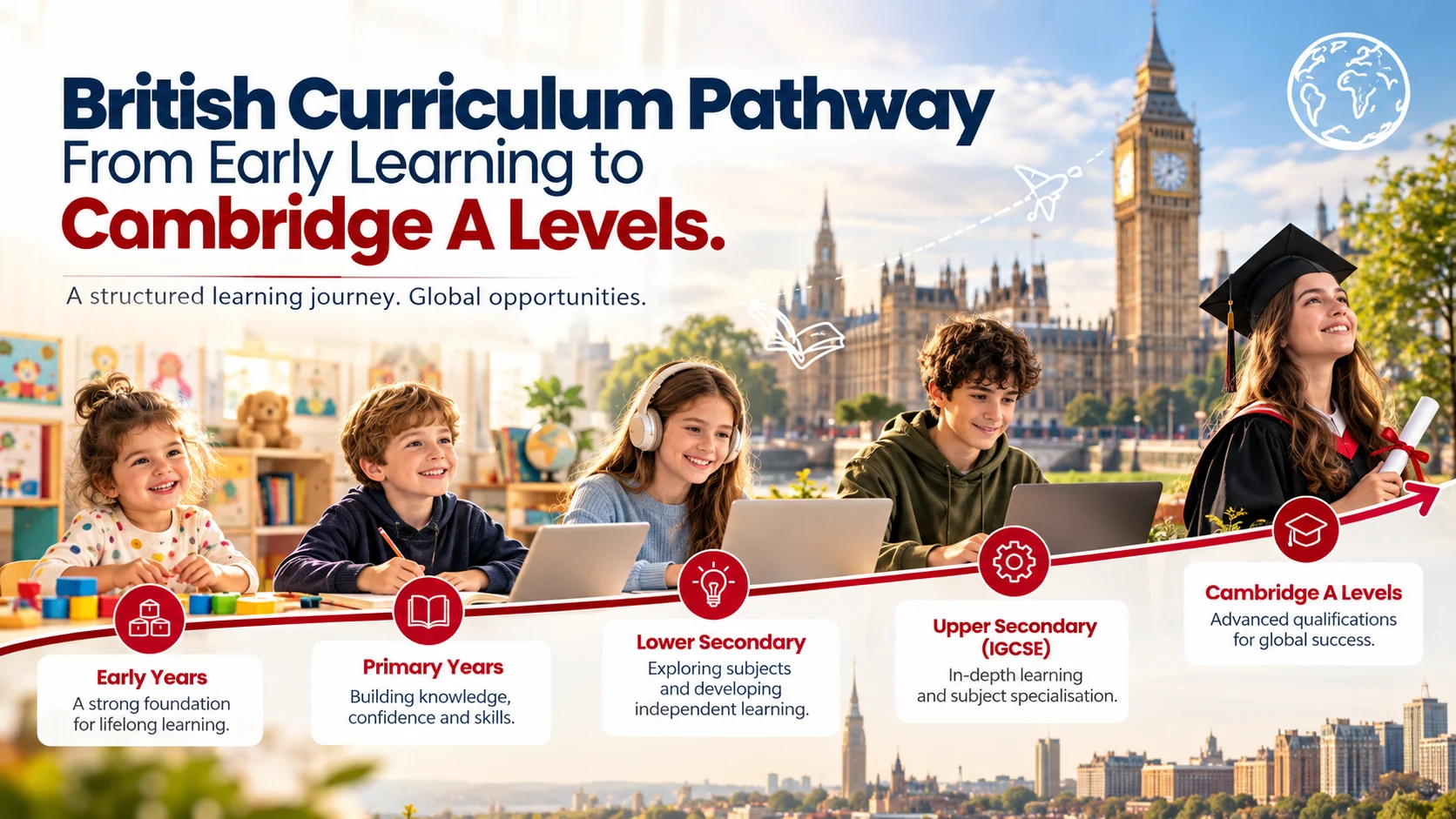
Choosing the right school curriculum is an important decision for parents. Beyond textbooks, examinations, and grades, a curriculum influences how children develop knowledge, approach problems, communicate ideas, and prepare for future academic opportunities. For families looking for a structured, internationally oriented education, the British curriculum is one option worth exploring.
The British curriculum is commonly associated with progressive learning, subject development, and internationally used qualifications. However, the term covers different educational pathways, and the structure, subjects, and qualifications offered can vary between schools.
Cambridge International, for example, offers a pathway that spans Cambridge Early Years, Cambridge Primary, Cambridge Lower Secondary, Cambridge Upper Secondary, and Cambridge Advanced. Students can progress from foundational learning to qualifications such as Cambridge IGCSE and International AS & A Levels.
Understanding these stages can help parents evaluate whether a particular programme suits their child’s age, interests, learning needs, and future plans. For families considering online schooling, it is equally important to understand how lessons are delivered, how progress is assessed, and what support students receive.
This guide explores the British curriculum from Early Years to A Levels, explaining its five stages, subject choices, assessment methods, learning outcomes, and considerations for choosing an online programme.
1. Understanding the British Curriculum
1.1 What Is the British Curriculum?
The British curriculum is a broad term used to describe educational programmes influenced by British education systems. International schools may offer different British-style programmes and qualifications, including those provided by Cambridge International and other examination boards.
It is not one identical curriculum followed by every school worldwide. Subjects, assessment methods, educational stages, and qualifications may differ depending on the programme.
Cambridge International provides an international pathway designed for learners across different countries and educational settings. Its programme includes stages from early years through primary and secondary education to advanced qualifications.
Parents should therefore look beyond the curriculum label when comparing schools. Understanding the examination board, available subjects, teaching approach, qualifications, and assessment arrangements is essential.
1.2 How Is the Cambridge Pathway Structured?
The Cambridge Pathway is organised into five broad stages:
- Cambridge Early Years: Develops foundational skills through exploration, communication, and age-appropriate activities.
- Cambridge Primary: Builds essential knowledge in subjects such as English, mathematics, and science.
- Cambridge Lower Secondary: Strengthens subject understanding, critical thinking, and independent learning.
- Cambridge Upper Secondary: Offers qualifications such as Cambridge IGCSE and Cambridge O Level.
- Cambridge Advanced: Provides International AS & A Level qualifications for students pursuing advanced study.
Each stage builds on earlier learning and prepares students for the next level. However, age ranges, subject availability, and progression requirements may vary by school and programme.
1.3 Key Features of the Cambridge Approach
Although teaching practices differ between schools, several characteristics are commonly associated with Cambridge International programmes.
Structured progression: Students develop knowledge and skills through successive educational stages.
Subject understanding: Learning encourages students to understand concepts and apply them, rather than relying entirely on memorisation.
Independent thinking: Students have opportunities to analyse information, evaluate ideas, solve problems, and explain their reasoning.
International perspective: Cambridge International programmes are designed for use in different countries and educational settings.
Assessment and feedback: Depending on the stage and qualification, assessment may include classroom activities, written work, projects, practical components, coursework, and formal examinations.
These features can support academic development when combined with effective teaching, constructive feedback, and appropriate student support.
1.4 How Does It Differ From Traditional Schooling?
The comparison depends on what a family means by traditional schooling. A British-style curriculum can be delivered in a conventional school or through an online programme. The curriculum itself and the way it is delivered are two different things.
British-style international pathways often follow defined educational stages and offer increasing subject specialisation during the senior years. Other curricula may organise subjects, assessments, and qualifications differently.
Indian curricula, such as CBSE, CISCE, and NIOS, have their own structures and requirements. American curriculum programmes may follow grade-level standards, credit requirements, and high school diploma pathways.
None of these labels alone guarantees a particular teaching quality or learning experience. Parents should compare actual programmes, available qualifications, teaching methods, and future academic requirements.
2. The Five Stages of the British Curriculum
The Cambridge pathway provides a progression from early childhood learning to advanced subject study. Understanding the five stages gives parents a clear overview of how students may develop academically over time.
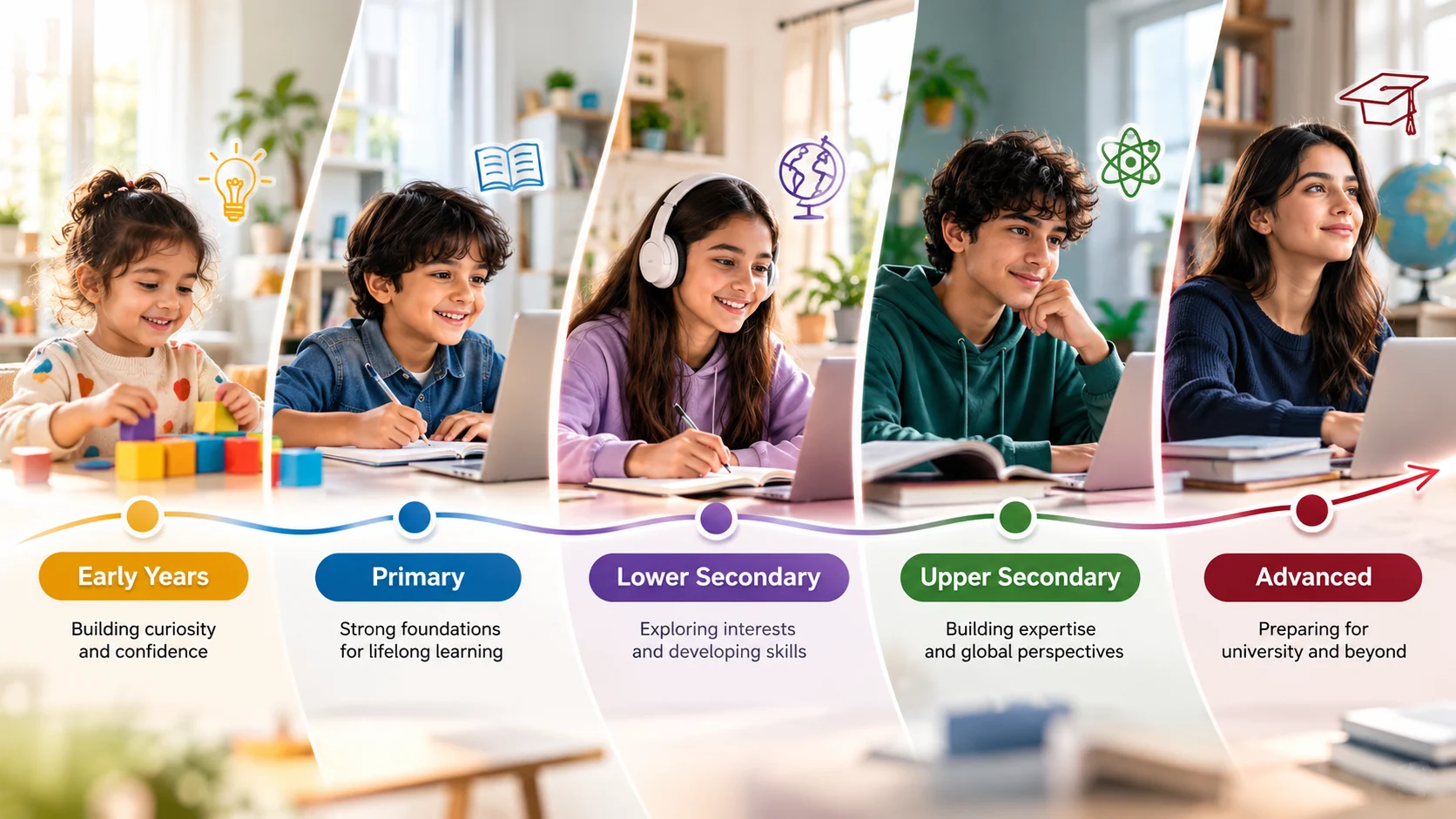
2.1 Cambridge Early Years (Typically Ages 3–6)
Cambridge Early Years focuses on foundational learning through exploration, communication, play, and age-appropriate activities. Children begin developing early literacy, numeracy, creativity, physical coordination, and social-emotional skills.
The aim is to encourage curiosity, confidence, and readiness for more structured learning.
2.2 Cambridge Primary (Typically Ages 5–11)
Cambridge Primary builds core knowledge in areas such as English, mathematics, and science. Depending on the school, students may also study languages, computing, art, music, and physical education.
Children develop reading, writing, reasoning, observation, and problem-solving skills while learning to apply concepts in different situations.
2.3 Cambridge Lower Secondary (Typically Ages 11–14)
Cambridge Lower Secondary strengthens subject understanding and introduces more complex concepts. Students develop critical thinking, research, independent learning, and analytical skills.
This stage helps prepare learners for Upper Secondary study by encouraging effective study habits and greater responsibility for their academic progress.
2.4 Cambridge Upper Secondary (Typically Ages 14–16)
Cambridge Upper Secondary commonly leads to qualifications such as Cambridge IGCSE or Cambridge O Level, depending on the programme and subjects offered.
Students study selected subjects in greater depth and work towards the relevant assessment requirements. Their subject choices may influence future educational options.
2.5 Cambridge Advanced (Typically Ages 16–19)
Cambridge Advanced includes qualifications such as Cambridge International AS & A Levels. Students specialise in selected subjects and develop deeper knowledge, analytical thinking, and independent study skills.
These qualifications are used by many universities internationally, but admission requirements differ. Students should check the requirements of their intended institutions and courses before selecting subjects.
The following sections explain each stage in greater detail.
3. Cambridge Early Years: Building the Foundations
Early childhood is a period of rapid development. Children begin to communicate more confidently, recognise patterns, explore their surroundings, and build relationships with others.

The Cambridge Early Years programme focuses on building these foundations through age-appropriate learning experiences.
3.1 What Do Children Learn?
Learning at this stage may include:
- Communication and language: Listening, speaking, storytelling, and expressing ideas.
- Early literacy: Recognising sounds, developing phonological awareness, and engaging with written language.
- Early mathematics: Exploring numbers, shapes, patterns, quantities, and simple problem-solving.
- Creative development: Drawing, music, imaginative play, movement, and creative expression.
- Physical development: Activities that encourage coordination and movement.
- Social and emotional development: Learning to share, cooperate, express feelings, and build relationships.
The focus is on helping children develop confidence and curiosity while becoming comfortable with learning routines.
3.2 Why Is Early Learning Important?
Children enter school with different interests, abilities, and experiences. A supportive early-years environment gives them opportunities to explore concepts at an appropriate pace.
Counting objects during an activity can introduce mathematical thinking, while listening to a story can develop vocabulary and comprehension. Group activities can help children practise communication and cooperation.
Parents should look for a programme that balances guided learning with opportunities for exploration, movement, creativity, and interaction.
3.3 What Should Parents Consider in an Online Early Years Programme?
Online learning for young children requires thoughtful planning. A programme should consider children’s attention spans, need for movement, opportunities for interaction, and the role of parents or caregivers.
Before enrolling, ask about live teaching, teacher-child interaction, activity materials, session duration, breaks, and how progress is communicated to families.
Explore the Early Years programme at K12 Online Schools for programme-specific information.
4. Cambridge Primary: Developing Core Knowledge
Cambridge Primary helps students strengthen essential knowledge and develop skills that support later learning. Children move beyond introductory concepts and develop a more organised understanding of different subjects.

4.1 Core Subjects and Learning Areas
Primary learning commonly includes English, mathematics, and science.
English develops reading comprehension, vocabulary, grammar, writing, speaking, and listening.
Mathematics covers number operations, fractions, measurement, geometry, patterns, and problem-solving.
Science introduces students to the natural world, observation, investigation, and scientific concepts.
Depending on the school, students may also study languages, computing, digital literacy, art, music, and physical education. The precise subjects available should be confirmed with the school.
4.2 Moving Beyond Memorisation
Students need to understand concepts well enough to apply them in different situations.
In mathematics, this could mean explaining how a solution was reached rather than simply writing the answer. In science, students might observe a process, record what happens, and discuss possible explanations.
Reading and writing activities can also encourage students to compare information, organise ideas, and communicate clearly.
These experiences help children develop confidence in their ability to learn independently while recognising when they need support.
4.3 Supporting Progress at Home
Parents can reinforce learning without turning every activity into a formal lesson. Reading together, discussing everyday observations, practising number skills, and encouraging children to explain their thinking can all support development.
For online learners, regular communication between parents and teachers can help identify areas where additional practice may be useful.
Families can explore the Cambridge Primary curriculum at K12 Online Schools for further programme information.
5. Cambridge Lower Secondary: Strengthening Understanding
Cambridge Lower Secondary marks an important transition. Students begin engaging with subjects in greater depth, encounter more complex ideas, and take increased responsibility for their learning.

This stage also helps prepare students for subject choices and qualifications in Upper Secondary.
5.1 Developing Deeper Subject Knowledge
Students may study English, mathematics, science, and other subjects depending on their school’s programme.
In English, they may analyse texts, develop structured arguments, and write for different purposes. In mathematics, they build on earlier concepts and work through more advanced problems. In science, they explore scientific explanations, evidence, and methods of investigation.
The aim is to move from basic familiarity towards a stronger understanding of how concepts connect.
5.2 Critical Thinking and Problem-Solving
Students may be asked to:
- Compare different explanations.
- Identify patterns in information.
- Support an argument with evidence.
- Investigate a question.
- Interpret data.
- Explain how they reached a conclusion.
- Review mistakes and improve their work.
These skills help students understand information, recognise relationships, and communicate their reasoning.
5.3 Preparing for Upper Secondary
Students approaching the end of Lower Secondary should gradually become familiar with the demands of more advanced study.
They may need support with time management, revision techniques, note-taking, independent research, and organising assignments.
Parents should ask how a school monitors progress, identifies learning gaps, and prepares students for IGCSE or other Upper Secondary qualifications.
For programme details, visit the British curriculum page at K12 Online Schools.
6. Cambridge Upper Secondary: IGCSE and O Level
Upper Secondary is the stage at which students commonly begin working towards qualifications such as Cambridge IGCSE and Cambridge O Level.

These qualifications allow students to study selected subjects and demonstrate their knowledge through the assessment methods specified for each subject.
6.1 What Is Cambridge IGCSE?
Cambridge IGCSE is an internationally used qualification designed for secondary-level learners. It offers a range of subjects, with assessment methods and content varying according to the subject and syllabus.
Students may choose subjects from areas such as:
- Languages and English.
- Mathematics.
- Sciences.
- Humanities and social sciences.
- Business-related subjects.
- Creative and technical subjects.
The actual subject list depends on the school, examination board, and available teaching provision.
6.2 How Does Subject Selection Work?
Subject selection can influence the options available to students later, so it deserves careful consideration.
Parents and students should discuss:
- Current interests and strengths.
- Subjects the student enjoys and is willing to study in depth.
- Entry requirements for possible future qualifications.
- Requirements for intended university courses or career pathways.
- The subjects the school actually offers.
- Examination arrangements and subject-specific assessment requirements.
A student interested in science-related university courses, for example, should check the subject prerequisites of potential programmes rather than relying on assumptions.
6.3 How Are Students Assessed?
Assessment varies by subject and syllabus. It may include written examinations, practical assessments, coursework, or other specified components.
Students should understand the assessment objectives and requirements for each subject early in the course. This allows them to plan revision, practise relevant question types, and seek feedback where needed.
Schools may also provide internal assessments to monitor progress before final examinations. These assessments can help teachers identify topics that need further attention.
6.4 What Is the Cambridge ICE Group Award?
The Cambridge International Certificate of Education (ICE) is a group award based on a combination of Cambridge IGCSE subjects across defined subject groups.
Eligibility and requirements should be checked against current Cambridge International guidance. It is not automatically awarded to every IGCSE student, and families should confirm whether their school offers the relevant subjects and whether the student meets the requirements.
7. Cambridge Advanced: AS & A Levels

Cambridge Advanced is designed for learners who are ready to study subjects in greater depth. International AS & A Levels are commonly used as preparation for higher education, although students may also pursue other educational or career routes.
7.1 What Are AS & A Levels?
Cambridge International AS Level and A Level are qualifications that allow students to specialise in selected subjects.
Some students take AS Level as a standalone qualification, while others progress from AS Level to the full A Level where the qualification structure allows. Families should check the current syllabus and assessment arrangements for each subject.
7.2 Why Does Subject Choice Matter?
Advanced-level study involves a greater depth of knowledge and a stronger expectation of independent work.
Students should investigate potential university courses and their subject requirements before finalising their choices. Requirements vary between countries, universities, and individual degree programmes.
Some degree programmes may require particular science or mathematics subjects. Others may place greater emphasis on essay-based subjects, languages, or a combination of disciplines.
It is important to check official university admissions information instead of assuming that one subject combination will suit every destination.
7.3 Skills Developed at This Stage
AS & A Level study can help students practise:
- Analysing complex information.
- Constructing evidence-based arguments.
- Applying subject knowledge to unfamiliar questions.
- Conducting independent study.
- Managing longer-term assignments and revision.
- Evaluating different perspectives.
- Preparing for advanced academic work.
These skills can support further study, but individual outcomes depend on the student’s preparation, performance, chosen subjects, and future requirements.
8. Subjects, Assessments, and Academic Progress
A curriculum is more than a list of subjects. Parents should also understand how learning is assessed and how progress is communicated.

8.1 Understanding Subject Choices
Subject availability changes between schools and qualification levels. Some schools may offer a broad range of subjects, while others may have a more limited selection.
Before enrolling, ask for the current subject list and check whether the school offers the combinations your child may need later.
Also confirm whether subjects are taught directly by the school, whether practical components are required, and how external examinations are arranged.
8.2 Cambridge Checkpoint, IGCSE, and A Level Assessments
Different stages use different assessment approaches.
Cambridge Checkpoint: Cambridge Primary and Lower Secondary Checkpoint assessments can provide information about student performance at the relevant stages. Availability and use depend on the programme and school.
Cambridge IGCSE and O Level: Assessment methods vary by subject and may include written examinations, coursework, or practical components.
International AS & A Levels: Assessment is subject-specific and follows the relevant syllabus. Students should understand the examination structure and assessment objectives for their selected subjects.
Parents should confirm which assessments are used by the school and whether students will take formal external examinations, internal assessments, or both.
8.3 How Can Parents Track Progress?
Useful progress reporting should help families understand more than a student’s overall grade.
Ask whether the school provides information about:
- Strengths and areas for improvement.
- Performance against learning objectives.
- Assignment completion.
- Assessment feedback.
- Attendance and participation.
- Support when a student is struggling.
- Preparation for upcoming examinations.
Progress reports are most useful when they lead to practical action. If a student struggles with a particular mathematics topic, for example, the next step might be targeted practice, a teacher discussion, or a revision plan.
8.4 Practical Exam Preparation Strategies
Effective preparation usually develops over time rather than relying entirely on last-minute revision.
Students can benefit from creating a realistic study timetable, revisiting topics regularly, practising questions in the required format, and reviewing mistakes carefully.
Past papers and specimen papers can help students understand question styles and timing, provided they use the correct syllabus and examination-session materials.
Parents can support this process by helping students establish routines, maintain a suitable study environment, and balance academic work with sleep, breaks, and other activities.
9. Skills Students Can Develop Through the British Curriculum

A well-delivered curriculum should help students build both subject knowledge and transferable skills.
9.1 Critical Thinking and Problem-Solving
Students may learn to examine evidence, identify assumptions, compare explanations, and justify conclusions. These skills can be applied across mathematics, science, humanities, and language subjects.
9.2 Communication and Research
Reading, writing, presentations, discussions, and research tasks can help students express ideas clearly and evaluate information.
Digital research skills are also important. Students need to learn how to assess sources, distinguish evidence from opinion, and acknowledge information used in their work.
9.3 Creativity and Independent Thinking
Creative tasks, investigations, open-ended questions, and independent projects can encourage students to explore different approaches to a problem.
The opportunities available depend on how the school designs its teaching and assessment. A curriculum alone does not guarantee that every student will develop these skills to the same extent.
9.4 Applying Knowledge to Real Situations
Students may encounter tasks that ask them to use classroom concepts in practical contexts.
A mathematics activity might involve interpreting a budget, while a science task could require analysing observations. A writing assignment might ask students to construct a reasoned argument for a particular audience.
Such activities help students see how subject knowledge can be used beyond a single lesson.
10. Is the British Curriculum Right for Your Child?
There is no single curriculum that is ideal for every learner. The right choice depends on a child’s interests, learning needs, academic goals, family circumstances, and future plans.

10.1 When Might It Be a Good Fit?
A British-style international pathway may be worth considering if your family values structured progression, internationally used qualifications, and the opportunity to specialise in subjects during the senior years.
It may also suit families who want their children to explore academic pathways that align with particular international university requirements.
However, these benefits depend on the specific school and programme. Parents should evaluate teaching quality, student support, subject availability, examination arrangements, and the child’s experience rather than choosing on the curriculum label alone.
10.2 British, Indian, and American Curricula: What Should Parents Compare?
The following overview is general. Each curriculum includes different programmes and can vary by school.
| Area | British-style international pathway | Indian curriculum | American curriculum |
| Structure | Often organised into stages leading to qualifications such as IGCSE and A Levels | Depends on the board, such as CBSE, CISCE, or NIOS | Often organised around grade-level standards and credit requirements |
| Subject specialisation | Typically increases in the senior years | Varies by board and grade; specialisation often increases in senior secondary | Varies by school and state; may offer electives and credit-based options |
| Assessment | May include external examinations and other syllabus-specific components | Varies by board and qualification | May include coursework, tests, projects, credits, and other assessments |
| Future pathway | Depends on qualifications, subject choices, and institution requirements | Depends on board qualifications and institution requirements | Depends on the diploma, credits, and institution requirements |
Before making a decision, compare the actual qualifications, recognition, costs, teaching approach, and future entry requirements associated with each option.
10.3 Questions Parents Should Ask Before Enrolling
Use these questions when speaking to a school:
- Which curriculum and examination board does the school follow?
- Which stages and subjects are currently available?
- What qualifications will my child work towards?
- How are teachers qualified and supported?
- How does the school monitor progress and address learning gaps?
- What live teaching and student interaction are included?
- How are examinations, practical assessments, and coursework handled?
- What additional costs may apply?
- What support is available for parents?
- How does the school help students prepare for their next educational stage?
Clear answers can help you compare programmes on their actual merits.
11. Understanding Online British Curriculum Education

Online education can make certain curriculum pathways accessible to families who need flexibility or cannot attend a suitable local school. However, an online programme should be evaluated carefully to ensure it provides the academic structure and support a child needs.
11.1 How Do Online Cambridge Classes Work?
Online schools may combine live lessons, digital learning materials, assignments, assessments, and independent study. The exact model varies.
Before enrolling, ask how many live lessons are provided, whether students can interact with teachers, how assignments are submitted, and what happens when a child needs additional explanation.
A programme should make its expectations clear so that students and parents understand the balance between scheduled classes and independent work.
11.2 The Role of Teachers and Digital Tools
Technology can support online learning by helping students access lessons, submit assignments, review resources, and receive feedback.
However, technology is not a substitute for effective teaching. Parents should understand how teachers explain difficult concepts, encourage participation, monitor learning, and respond to individual questions.
Ask whether the school provides a learning management system, progress reports, teacher communication channels, and technical support. Also consider the quality of the internet connection and the devices required.
11.3 Assessment and Progress Tracking
An effective online programme should explain how it evaluates student learning.
This may include classroom participation, assignments, quizzes, internal examinations, feedback, and formal assessments where applicable.
Parents should be able to understand how their child is progressing and whom to contact if they notice a difficulty.
11.4 What Should You Check Before Choosing an Online School?
Consider the following:
- Curriculum and qualifications: Confirm the exact programme, examination board, and qualification pathway.
- Teaching and interaction: Ask about live classes, teacher access, class size, and student participation.
- Subject availability: Confirm that the required subjects are offered at your child’s stage.
- Assessment arrangements: Understand internal assessments and external examination requirements.
- Student support: Ask how academic difficulties and technical issues are handled.
- Recognition: Verify relevant accreditation, authorisation, and qualification recognition through official sources.
- Costs: Request a clear breakdown of tuition, examination fees, learning materials, and additional charges.
- Future progression: Check whether the programme meets the requirements of potential future schools or universities.
These checks are important because the words “online British curriculum” do not, by themselves, establish the quality or recognition of a particular programme.
12. Exploring the British Curriculum at K12 Online Schools
For families exploring an online British-style education, K12 Online Schools provides a starting point for learning about its curriculum and programme options.
Parents should review the school’s current programme information to understand which stages are available, how learning is delivered, what qualifications are offered, and what support students receive.
12.1 Finding the Right Stage for Your Child
The most suitable entry point depends on your child’s age, previous schooling, current academic level, and the programme’s admission requirements.
Families with younger children may focus on foundational learning, communication, and early numeracy. Primary and Lower Secondary families may be more concerned with subject development and academic progress. Students approaching IGCSE or A Levels may need to consider subject combinations, examination arrangements, and future educational requirements.
Ask the admissions team to explain the appropriate entry stage and any assessment or documentation needed before making a decision.
12.2 What Should Families Confirm?
Before enrolling, ask K12 Online Schools to confirm:
- The programme and curriculum pathway currently offered.
- The stages and subjects available for your child’s age and academic level.
- The qualifications students can pursue.
- The delivery of live classes and independent learning.
- Teacher support, feedback, and progress reporting.
- Examination arrangements and relevant fees.
- Current accreditation or authorisation details.
- Admission requirements and the next steps in the application process.
These details help families determine whether the programme aligns with their expectations and their child’s long-term plans .
Looking for the Right British Curriculum for Your Child?
Every child has different learning needs and future goals. Connect with the K12 Online Schools team to explore available programmes, understand the admission process, and find the right learning pathway for your child.
Stay Connected with K12 Online Schools
Follow us on Instagram for more learning insights, school updates, and a closer look at life at K12 Online Schools.
K12 Schools – Follow us
Frequently Asked Questions
Q1. At what age can a child start the British curriculum?
Answer: Some British-style programmes begin in the early years, often around ages three to six. The appropriate starting age depends on the school, programme, admission requirements, and the child’s developmental readiness.
Q2. Is the British curriculum the same as the Cambridge curriculum?
Answer: No. British curriculum is a broad term for different British-style educational programmes. Cambridge International provides a specific international pathway with its own stages, syllabuses, and qualifications. Parents should confirm which curriculum and examination board a school follows.
Q3. What is the difference between IGCSE and A Levels?
Answer: Cambridge IGCSE is generally taken during Upper Secondary, commonly around ages 14–16. International AS & A Levels are advanced qualifications, commonly studied around ages 16–19, that allow students to explore selected subjects in greater depth.
Q4. Can students study the Cambridge curriculum online?
Answer: Some schools offer online Cambridge pathway programmes, but availability varies by stage, subject, and school. Parents should confirm the curriculum, teacher interaction, assessment arrangements, examination access, and recognition of the qualifications before enrolling.
Q5. Are Cambridge qualifications recognised by universities?
Answer: Cambridge qualifications are used by many universities internationally, but admission requirements differ by institution, course, country, and qualification. Students should check the official admissions requirements of their intended universities and confirm that their subject choices meet those requirements.
Q6. How do I choose the right British curriculum programme for my child?
Answer: Start by considering your child’s age, previous education, interests, learning needs, and future goals. Compare the programme structure, subjects, teaching support, assessment methods, costs, and qualification recognition. Ask the school to explain the appropriate entry stage and available progression options.
Q7. What subjects can students study under the Cambridge pathway?
Answer: Subject options vary by stage and school. They may include English, mathematics, science, languages, humanities, computing, creative subjects, and other specialist areas. At IGCSE and A Level, availability depends on the school’s offering and the relevant syllabus.
Q8. Does studying the British curriculum guarantee admission to an international university?
Answer: No. A curriculum or qualification does not guarantee admission. Universities consider their own entry requirements, which may include grades, subject combinations, language proficiency, and other application materials.
Conclusion
The British curriculum offers a structured route from foundational learning in the early years to more specialised study at IGCSE and A Level. Along the way, students can build subject knowledge, practise independent thinking, and develop skills that support further education.
However, the curriculum name alone should not determine a family’s decision. The programme, teaching quality, subject availability, assessment arrangements, student support, and recognition of qualifications all deserve careful consideration.
For parents exploring online education, the next step is to compare specific programmes and ask how they will support their child’s progress at each stage.
K12 Online Schools can be one option to explore as part of that process. Review the current curriculum information, clarify the available pathways with the admissions team, and choose a programme that fits your child’s learning needs and future plans.
Comments are closed